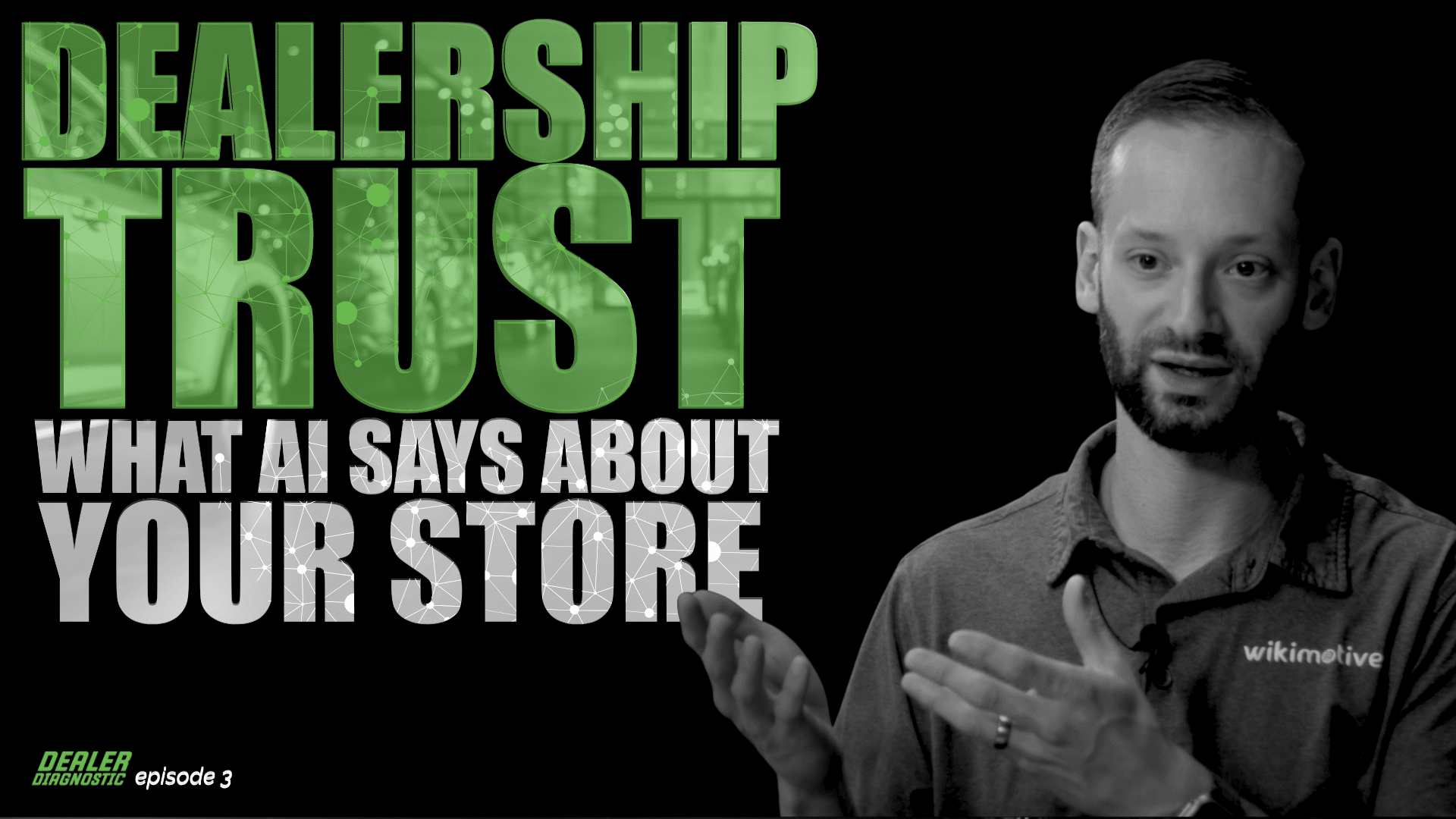
Wikimotive sat down with Co-founder and CEO Zach Billings to ask him over 50 questions about automotive search marketing that are relevant to dealers everywhere. In the third installment of this 7-part series, we take a look at dealership trust—how AI surfaces patterns in customer reviews, what content and SEO can accomplish, and why improving your reputation starts with the experience your store delivers.
Why does trust seem to matter more today than it did five years ago?
Trust matters more today than it did five years ago because it’s easier to determine whether you’re trustworthy as a business.
Five years ago, if a consumer wanted to know, is this a good dealership to work with or not? Yes, they could look at star rating, but people always went and read the reviews. And what did everyone know that consumers did? Default to the one and two star reviews. People wanted to know what the problems were, but they had to read them one at a time.
Now there’s this awesome shortcut. You go to ChatGPT and you say, what don’t people like about working with ABC Motors? And it pulls in a distillation of the common themes across all of the negative reviews.
You can’t hide anymore. And the more people use LLMs, which everyone has accepted that people are going to, the more you won’t be able to hide. The only way to instill trust in the consumers that you want to serve and that you want to do business with you is to actually be trustworthy. You’re not gonna be able to game that system anymore.
Dealer Takeaway: AI makes recurring customer complaints easier for shoppers to uncover. Review the patterns in your negative feedback and address the experiences behind them before they become reasons to avoid your store.
What signals tell Google, ChatGPT, or customers that a dealership is trustworthy?
Whether it’s Google, whether it’s ChatGPT, whether it’s Gemini, whatever the platform, the common thread is going to be consensus when it comes to trust.
LLMs literally use consensus to be able to decide what a correct answer actually is. Google uses star rating and sentiment to be able to figure out what should be elevated to the top. And the common thread, reviews.
Reviews can sometimes be in the form of Google reviews. It could be Yelp. It could be DealerRater. It could be sentiment on a Reddit thread if somebody’s talked about you. But the common thread here is that what people have to say about you when their answers cannot be manipulated is the truth about you as far as the Internet is concerned. So at the end of the day, reviews, reviews, reviews in all forms.
Dealer Takeaway: Look beyond Google’s star rating. Review feedback across Google, Yelp, DealerRater, and relevant online discussions to understand whether customers consistently describe your store as trustworthy.
How do reviews influence visibility beyond just star ratings?
Reviews influence visibility beyond star ratings in… First in the SEO space where really 99.5% of opportunity is in that you have reduced friction to ranking and also reduced friction to better placement in paid search results if you have a better star rating. Okay? So if a consumer is looking for dealerships, even if they’re not paying any attention to what the star rating is and they’re not looking for local listings with star rating, they will still see your dealership in higher positions on average, both in paid and in organic because you had better reviews.
And then that same premise carries over to the LLMs where if you ask best Ford dealer near Dallas and then you ask it, how did you rank the responses you gave to me? It will essentially tell you, I ranked them in order of reviews and maybe modify them a little bit by your location relative to those dealerships.
Dealer Takeaway: Assess what customers repeatedly say alongside your review count and average rating. Test how your dealership appears in recommendation prompts, then compare those answers with the underlying reviews to identify concerns worth investigating.
Can a dealership manufacture trust through content or SEO tactics?
Dealerships cannot manufacture trust through content or SEO tactics.
You can use content and SEO tactics as a lever and maybe even I would call it a hedge against review issues, but you can’t use them to create positive reviews. Positive reviews and reputation are created at the dealership level, at the consumer experience level, and you only have so much ability to gain that one way or the other. You can’t manufacture that. What you can do is if you have the same star rating, same number of reviews as your primary competition, let’s say you’re in a market where all the dealerships have 4.6 stars and a lot of reviews, and it’s a pretty even playing field, the way you can differentiate yourself with content and SEO is not by getting better reviews, but by showing up in more prominent positions despite the fact that the reviews were on an equal playing field.
Dealer Takeaway: Give your marketing team real strengths to communicate, backed by the customer experience. Content and SEO can help differentiate your store, but operational problems require operational fixes.
Why are some stores becoming sources that AI systems cite while others aren’t?
Dealerships being cited in AI answers usually has more to do with having the right content than any other particular factor.
The mistake is in worrying about being cited at all because the queries and prompts that lead to a dealership being cited as the answer are almost always high funnel. When you produce or when you enter a low funnel prompt, an inventory oriented prompt or a dealer discovery oriented prompt, it’s no longer content like blog articles or pages that shows up, certainly not ones that are written by a dealership. And so ultimately, it’s a moot question to worry about why some dealerships are cited and some dealerships are not because the things that we’re worried about citations for are all high funnel.
Dealer Takeaway: Before chasing citations, identify the shopper intent behind the prompt. Evaluate whether that visibility reaches researchers or people seeking a dealership and inventory, then measure whether it produces meaningful customer opportunities.
What mistakes are dealers making when they think about reputation management?
The biggest mistake that dealerships are making when thinking about reputation management is they’re thinking about managing their reputation after the review has already been left.
The ship has sailed at that point. Yes, you can sometimes turn around a negative review by reaching out to the customer and trying to turn around the problem. But once the review has been left, for the most part, that person’s already had the experience that they’ve had positive or negative. What dealerships need to switch to is thinking about reputation before the review is left. And both conveniently and inconveniently, LLMs can curate, AI search tools can curate these answers, right? So you can ask an LLM, what is the thing that people dislike most about working with my dealership? You can get consistent answers and you can go try and address those problems.
That’s where you need to be thinking about reputation management, not after the review is already in ink.
Dealer Takeaway: Extend reputation management beyond responding to published reviews. Use recurring complaints to identify where your sales or service processes disappoint customers, and correct those problems before the next review is written.
If a dealer wants to improve trust over the next six months, where should they start?
If a dealership wants to improve trust in the context of AI search or regular search over the next six months, you start by asking your preferred LLM, what don’t people like about working with my store? Let’s say the answer is people commonly complain about bait and switch. It’s a common concern that shows up in reviews. You’re gonna need to address that not by sweeping it under the rug or coming in and and trying to address the people who voice that complaint on the Internet, you’re gonna have to look at how you address that practice at square one, and that’s a difficult thing to do.
That is much easier said than done. We need to be profitable. Right? We’re we’re in business to be profitable.
We have to be, And we still need to get people to come into the showroom. So how do you avoid sometimes having somebody feel like they got bait and switched? It happens once in a while, but you’re going to need to address this at a process level, and you’re going to need to instill new requirements on your staff to change these things at the source if you really want to take seriously improving your reputation into the foreseeable future. And the way to do it is to start by figuring out what are the common complaints and then be ready for some uncomfortable changes at the dealership level.
Dealer Takeaway: Ask an AI platform what customers dislike about your store, verify the recurring themes against actual feedback, and assign ownership for fixing the underlying processes. Set clear staff expectations and track whether those complaints become less frequent.