
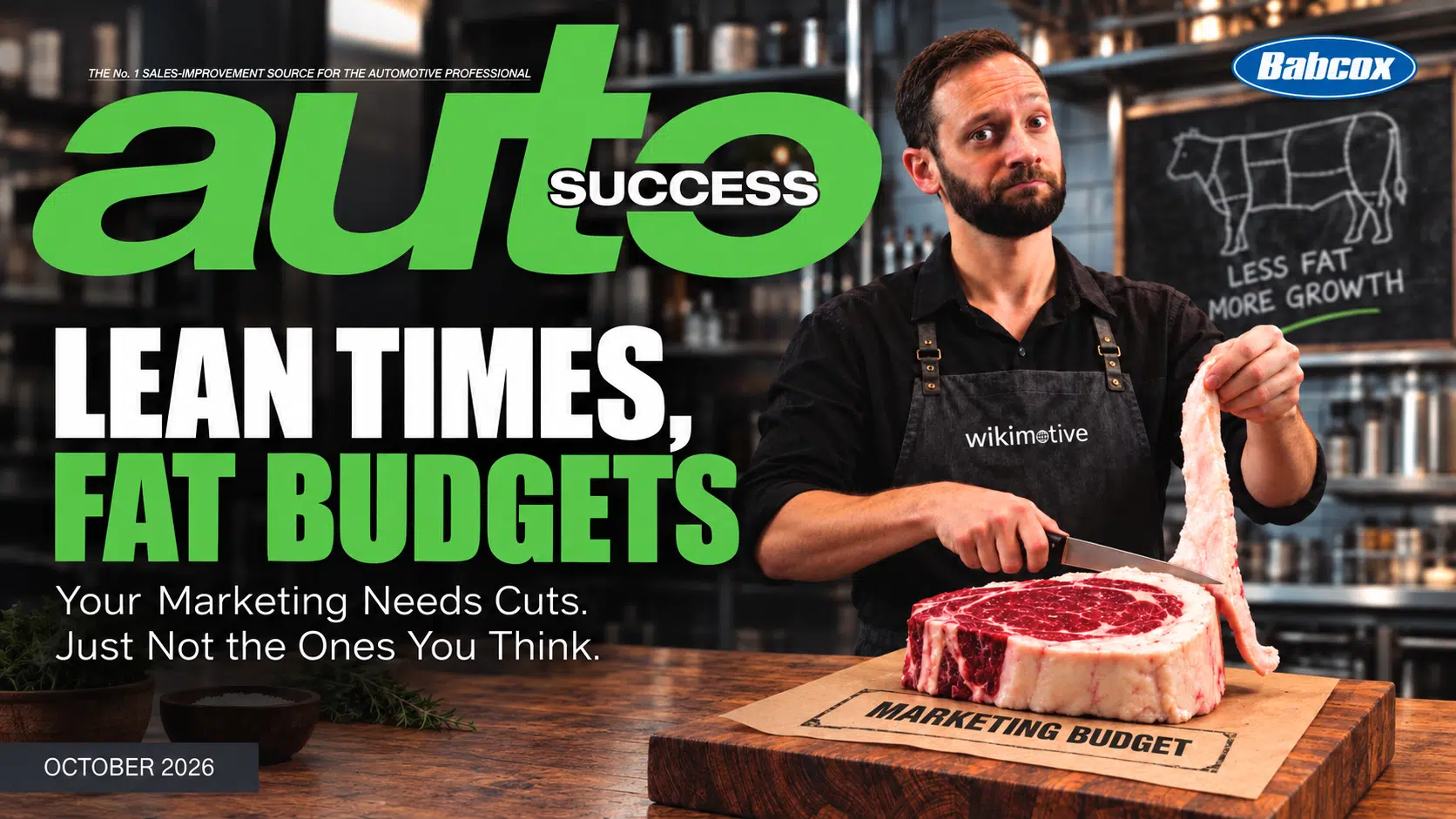
Originally published as the cover feature in the October 2026 issue of AutoSuccess Magazine, this article by Wikimotive Co-founder and CEO Zach Billings challenges dealers to examine what their marketing dollars actually produce. Zach outlines how to uncover waste across vendors, campaigns, and website tools—and reinvest those savings into measurable opportunities to sell and service more vehicles.
Frustrating times… Sales are not where they should be. Gas is expensive. Rates are stubbornly elevated. Midterms are around the corner — and make no mistake, when they’re over, 50% of consumers won’t like the outcome.
For better or worse, we’re waging trade wars on multiple fronts. Consumer affordability is crunched, their confidence shaken and the holiday season is almost here. More dollars are going toward Christmas presents, and consumers are pushing off that vehicle purchase until the world (and their credit card) cools down.
You look at the news and see all this, then look at your statement. You’ve already concluded you’re spending too much money for the moment we’re in — qnd you’re right: there’s fat to cut. Let’s figure out what can go, what deserves more and how to put the savings back to work. There are still cars being sold, and more of them can be yours by spending smart, not spending more.
Ready? Let’s go.
Before You Cut
Let’s start with the principle that marketing is supposed to generate outcomes. Outcomes are not traffic, impressions or AI citations; they’re leads, calls, showroom visits and sales. Evaluation of marketing and marketing waste must always flow from that reality.
Just because leads and sales are down does not automatically mean your marketing isn’t working. It might be, but then which part is failing you? How much of the problem is the marketing and how much is the market? How much is your process? Your people?
Your vendors don’t get to hide behind the market. You don’t get to blame them just because sales are down. Measure first, then decide what needs to change.
The car business does fluctuate, and the SAAR is coming in lower than was anticipated at the start of the year for many of the reasons I listed above. We are in a headwind — make no mistake — and now we need to do something about it.
Many dealers can sell 20% more cars without increasing their budgets, when executed with full commitment – we have seen that and more in practice. It starts by analyzing your spending channel by channel, tool by tool, and cutting the fat and the vestigial appendages that you signed up for years ago and haven’t used in years.
Each marketing channel delivers results in different ways, but most can be measured with high confidence. The goal isn’t to chop spending to zero; it’s to trim everything that isn’t working and then reinvest 50-100% of that back into marketing that pulls its weight. Spending is good when the spend sells cars.
Tear It Down
We’re going to rip up your marketing channels and leave only what’s working. Then we’re going to rebuild it to prioritize outcomes.
I’m going to unpack the common problems you’re running into in each major marketing channel and give you a framework for asking questions of each one.
SEO, GEO, AEO
Your SEO is supposed to get you ranked higher on Google organic search and local results. GEO is the AI version of this, and despite what you might be hearing, GEO (and its close cousin, AEO) are 95% SEO fundamentals. There is next to nothing a vendor can do for you that’s GEO-specific beyond what they already should if they do quality SEO.
The deliverables of SEO are content, local listings management and technical SEO/GEO. The quality of those deliverables dramatically impacts whether this marketing channel is your biggest winner or money lit on fire every month. There isn’t much room in between.
So how do you spot bad SEO?
If the content is AI-generated or the pages are consistently fewer than 1,000 words, cut.
If the strategy is cookie-cutter and your vendor can’t explain their reasoning, cut.
If your vendor quotes AI buzz topics to you, shows you AI visibility scores or has tried to sell you a GEO/AEO package, cut.
If your vendor’s results are measured in metrics (traffic, rankings, impressions) rather than outcomes, cut!
A thousand words isn’t magic; it’s a practical benchmark based on the stronger performance we’ve seen from pages over that mark. But note that a thousand words of fluff is still fluff. The point is substance: Answer the questions a shopper would actually ask and give them a reason to buy from you.
What you need to understand about SEO is that no harm comes to your web presence if you cut ineffective SEO. I often talk to dealers who are afraid to go months without SEO. If your solution is producing more outcomes (leads, calls, etc.) than the market would naturally, then ignoring SEO is a justified fear. If the SEO is cookie-cutter, AI-generated, low effort and under $3,000 per month, it’s almost certainly going to do no harm to cut it while you figure out where you should be investing instead.
SEM, VLA, PMax
When I help dealers look for waste, I often find that more than 30% of their paid search spend is being wasted. Pause for a moment and think about what your total paid search budget is (including VLA and PMax). Is 30% a meaningful number?
I’m going to help you understand what “waste” means in this context and which questions to ask. Fully analyzing this is its own article, but here are the broad strokes…
SEO cannibalization is paying for a click that organic search would have delivered for free.
When you already rank first organically, your paid ad can intercept that click and make the vendor’s report look productive without bringing you another shopper. Start with searches for your own dealership name. At $2 per click, 1,000 unnecessary clicks amount to $2,000 per month in waste.
PMax campaigns are the most common source of overall waste, including organic cannibalization. PMax stands for Performance Max, and it’s a type of campaign where the vendor does next to no work, and Google does all the steering programmatically. If your vendor is running a PMax campaign, you’re paying them a management fee or a cut of spend to pass the money on to Google and just loosely define where to target.
PMax is lazy and imprecise. Google keeps people on this drug by getting the cheapest possible clicks and conversions, such as keywords like your store name, which you already rank for organically.
Ask your vendor if they use PMax. The answer should be no (except for VLAs, which have to run through PMax).
Ask your vendor specifically how they avoid organic cannibalization. I promise, even if you don’t know jack about paid search, a quality answer will be easy to understand. If their answer doesn’t leave you feeling satisfied, they’re hedging or they don’t know.
Social Ads and Display
Social ads, display and retargeting tend to produce large traffic volumes but very little measurable conversion to leads. This is directly measurable in your Google Analytics with little difficulty.
The best social ads are inventory-specific and will have a low conversion rate but still a solid cost per lead. Display is often bundled with paid search and sold as “retargeting” — the promise is that your ads follow shoppers around the web until they come back and buy. But browser and privacy restrictions have punched holes in that promise, and showing an ad to someone who later buys doesn’t prove the ad helped sell the car.
My advice for dealers is to cut it. Put those dollars into marketing that earns its place with real sales opportunities.
Third-Party Listings
Third parties are a drug. Sometimes there would be serious withdrawals if you got off, but most of the time the fear isn’t justified, and the withdrawals aren’t even noticeable with a healthier replacement vice. The claim goes that third parties drive gobs of assisted conversions. People who see a car on their site and later come back to your website or your store in another way. This is mostly BS.
I’ve worked with dozens of dealers who have quit some or all of their third parties cold turkey and never noticed a difference. The key is knowing which ones you can cut, and that’s very simple to determine.
Go to your CRM and take the total front and back gross from all your deals with a particular third party over the last three months. (Increments of three months help eliminate that one mega deal or the car you gave away.) Divide that by the cost of the listing site for that period. If the result is under 2, cut the third party. If the result is under 3.5, it’s likely you can do better with another marketing channel.
For example, if you gross $24,000 over three months, and that third-party site costs $4,500 per month, then 24,000 ÷ 13,500 = 1.8. Since 1.8 < 2, the math recommends a cut.
The third party referrals to your website are usually not a significant factor in this, unless that’s the only way they provide value. For listing sites that send leads directly to your CRM, their website traffic addition usually isn’t enough to add one sale’s worth of attribution.
Traditional Marketing
TV, billboards and radio are very market- and circumstance-specific. They do work in some markets, but they work poorly in most others. Typically, I don’t see harm in cutting here. OTT and direct mail are flavors of traditional marketing that have stronger legs. OTT can vary in value depending on your provider, but it can always benefit your branding. Direct mail also has merit if done well.
In general, traditional marketing is more specific to market dynamics and how well the campaign is executed. Usually, when it’s working, you know it; you hear about it. If you’re not sure, it’s smart to cut here until you’ve built momentum and can reconsider.
Website Packages and Dusty Old Moving Boxes
Website package specifics, chat, trade tool, second trade tool, third trade tool, phone tracking, etcetera — name every single one on a spreadsheet, with as much as you know about it in a notes column. Go through one by one, determining if you’re using it and if it duplicates or overlaps with anything else. It still shocks me when I help dealer partners with this and regularly find four or even five digits’ worth of waste hidden here.
Before you go hacking at your marketing, this is the first thing to audit because you may be surprised by what you find. The hardest thing about this is admitting you let it happen for so long.
Hang up your pride before you start this investigation and find that waste!
Rebuild Better
The most successful dealers I spend time with do this whole exercise when the sun is shining. Then, when the market seas get rough, they don’t have to do it under pressure. They even add new tactics when things are rough to press their competitive advantage.
What I want you to understand is that spending isn’t the enemy… Waste is the enemy.
Find $10,000 a month in waste, then put $5,000 back into marketing that earns its keep. You’ll have cut your bill by $5,000 and given your best channels more to work with. If the results justify it, reinvest the other $5,000, too. Same budget. More of it working to sell cars.
When we help our dealers rebuild after a pruning analysis, we always start with the principles: outcomes (leads, calls, showroom visits, sales) are the goal, and the rest is fluff. This is how you build lean and stay lean.
You also need to take a balanced approach, mixing short-term marketing like paid search and paid social with compounding long-term marketing like SEO.
Quality SEO solutions focus on low-funnel intent, deliver high-quality human work, explain to you why the strategy was planned the way it was and report on outcomes, not feel-good metrics.
Quality SEM rejects most automation in favor of human campaign curation. It’s focused not only on driving efficient outcomes for your ad spend but also on preventing overlap that steals those outcomes from the organic presence you already have.
One or two third-party vendors may be healthy, but measure them and let the numbers make the decisions. I’m sure your rep is nice and means well; I’m also sure they’re pumping you up with FOMO, and it’s clouding your judgment if you’re holding on to a third party that doesn’t win on the numbers.
Use and invest in tools that convert customers on your website or improve your process. Don’t fall into the trap of signing up for tools that promise quick fixes and replacing thinking with AI. It won’t pan out the way it does in the sales pitch.
Lastly, invest in a real partner. That could be a brilliant marketing director or a fractional CMO, but it doesn’t always have to be a unique cost. A GSM with serious digital chops who knows how to hammer on the latest AI models might be your guy. Your digital marketing vendor whos devoted to quality and results may be a trusted partner that’s already baked into your services.
The point is that you need someone who knows how to ask the right questions, measure your marketing performance and act in your best interest while educating you along the way. We might be unicorns, but we do exist.
How to Uncover Waste
Anyone claiming to have the magical dashboard or the crystal ball for this is full of BS. Data and wisdom are all you need.
It’s OK if you don’t have them in the area of marketing — your profession is selling cars — and if that’s the case, I offer a free review of a dealer’s full marketing budget, lead reports and channel performance with actionable recommendations. No pitch required; the price is that you have to show up, roll up your sleeves and go over the work together with me. I also offer virtual or in-person seminars on these topics for dealer groups and 20 groups trying to navigate these choppy waters.
Reach out to me on LinkedIn or Wikimotive’s website — just ask for Zach and you’ll get to me easily. You bring the info — don’t worry, I’ll give you instructions, and you’ll leave knowing what’s fat and where to turn it into lean muscle.