

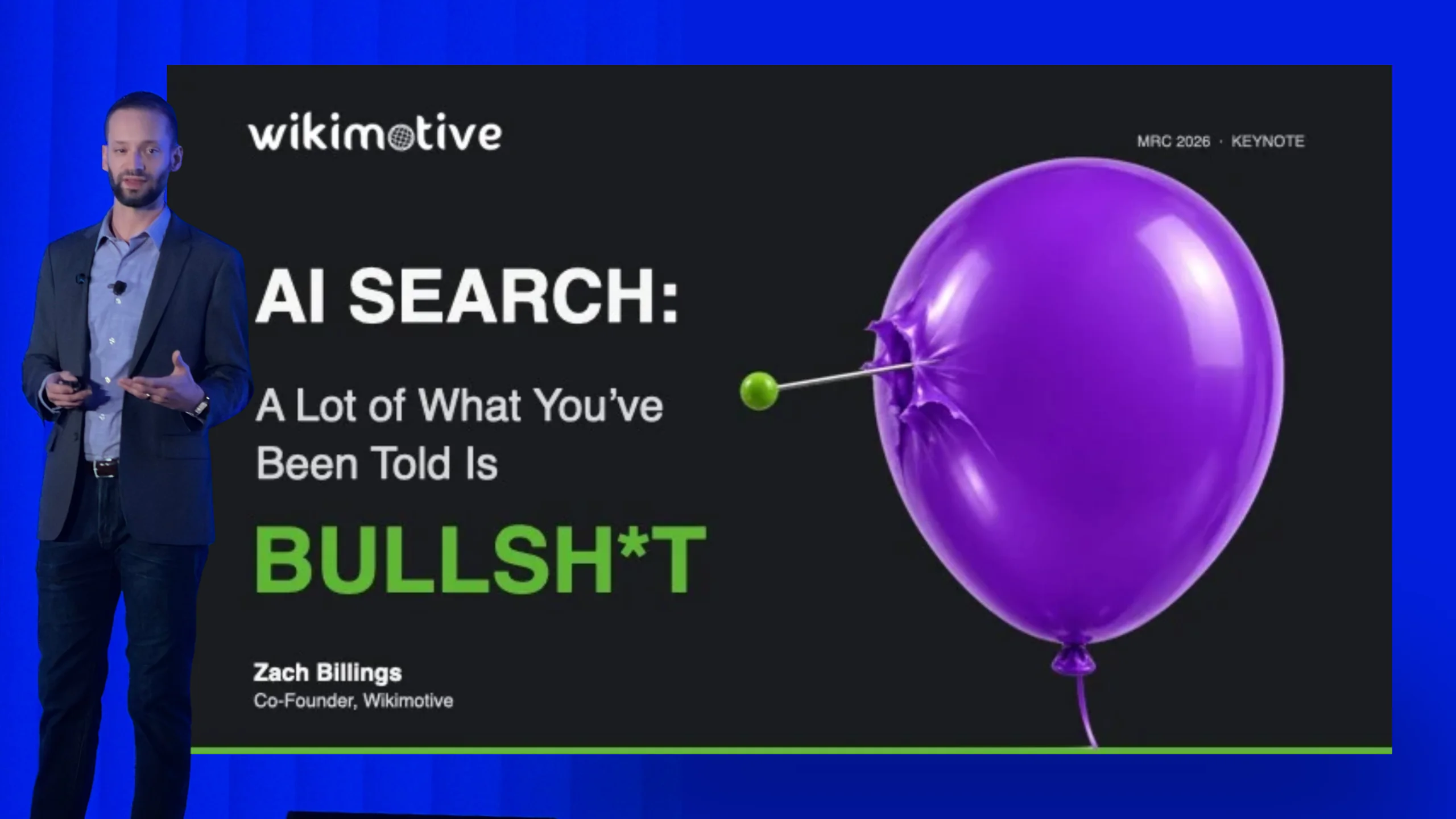
AI search is creating new ways for shoppers to find your dealership. But does every increase in AI traffic justify a budget shift—and does every new GEO service add something your existing SEO strategy doesn’t already cover? In his main-stage keynote at the 2026 Modern Retailing Conference, Zach Billings, Wikimotive’s Co-Founder and CEO, examines those questions through dealership analytics, Wikimotive’s ongoing AI visibility research, and examples of coordinated search marketing.
Zach explains the difference between being cited, being recommended, and earning a visit from a shopper ready to act. He also challenges commonly promoted AI search shortcuts, discusses where human expertise belongs in content production, and shows how paid search can compete with organic visibility instead of expanding a dealership’s reach. His central question throughout: Is your marketing creating additional opportunities to sell and service cars?
What Could Your Dealership Be Losing?
- More visibility. No more buyers. Could the results your vendor celebrates have little connection to selling or servicing cars?
- An urgent pitch. An expensive mistake. Are you shifting budget because the opportunity has changed—or because someone made falling behind sound inevitable?
- Another service. No clear advantage. Before you pay for GEO, how will you know whether you’re buying anything your store actually needs?
- A shopper ready to buy. A competitor gets the call. What could be keeping your dealership out of the conversation?
- Cheaper content. A costly tradeoff. Could today’s production savings undermine the visibility you’ve spent years building?
- The same budget. Less opportunity. How much of your advertising spend is reaching customers you would have reached anyway?
- Better reports. A dealership that isn’t growing. Would you recognize the warning signs before approving another month?
Watch or read Zach’s keynote to identify where your dealership could be exposed—and what deserves your attention before your next marketing decision.
Full Transcript
The transcript below reflects the presentation and discussion at MRC 2026. Research findings describe the observed sample and establish associations rather than causation. Platform observations and predictions reflect the time of the keynote.
Zach Billings:
Alright. Zach Billings, co-founder of Wikimotive. If you guys don’t know us, we’re a boutique marketing agency with a specialization in search.
And ever since ChatGPT was nice enough to come on the scene, I have had to do so, so much research to keep on answering questions and making this relevant and new.
And it’s new again, I promise. The topic, the fundamental topic here, is boring. How do we show up in search? Again, just a new flavor of the same thing, right? But it’s constantly changing, and all of you wanna know the answer to the question “What is it that makes me show up on ChatGPT or Claude or in an AI Overview?” Right?
So before we get into all the ins and outs, and you know I’m the, what, seventh vendor to tell you an eighth different thing that’s true about this, I wanna set the table a little bit.
Those of you who have seen me do this kind of thing before know I like data and I like evidence. Internally, when we talk to our clients, or when I do one of these, I like to underpin our findings, our assumptions until we prove them otherwise, with data and studies. Sometimes those studies are things that we perform. We look at large volumes of data to try to find out what’s true and what’s not. We also look outside of the automotive industry. We look outside of our own echo chamber to see whether other studies agree with what we think is going on.
So I’m gonna show you a bunch of that today, and I think it’ll be illuminating. But first, let’s get on the same page. Everything I’m gonna talk to you about has to be underpinned by one truism.
Marketing Has to Create Opportunities to Sell and Service Cars
Our marketing has to create opportunities for us to sell and service cars.
Right? Does anyone disagree with that?
Everything else is vanity metrics. It’s a safety blanket. If we’re not producing calls, forms, and butts in seats, then the marketing didn’t work at the end of the day. It’s just vanity metrics.
So everything I talk about is underpinned by that. Let me give you a clear example.
If somebody does… It could be a Google search query, or it could be a prompt on ChatGPT. If somebody asks how much an F-150 can tow, they want info. Maybe they want to buy soon. Maybe they want to buy a trailer soon. I don’t know yet.
What I do know is that if I show up in an AI Overview as a cited answer to that, even if I get traffic to my website, does it convert? Those of you who spend any time in your analytics, who’ve looked at your blog traffic…
If you’ve looked at the key events, there are none.
Okay? If somebody searches “F-150 for sale,” or they use a prompt like “I want an F-150 XLT in blue with this equipment, and I’m looking for the cheapest one I can find in my area”…
It’s a transactional search. Different phraseology. Okay? So before we assume a metric is relevant to our bottom line, to our opportunities to sell and service cars, we have to make sure we’re aiming for the ones in green, the ones that signal transactional interest.
How Much Dealership Traffic and Conversion Activity Comes From AI?
So here’s the first bit of data. For those of you who have seen me do this before, this is the fresh version. Okay? Those of you who haven’t will find this interesting.
We keep on adding more and more dealers to this. It’s a study where we’re mashing together the analytics for what is now just shy of 300 dealers.
What you’re looking at is the visits, the referrals from ChatGPT in blue. Gemini, Claude, and all the others are in those other colors there. For those of you who are Claude users and, like, turn up your nose anytime someone says “ChatGPT,” I’m sorry to break it to you, but consumers use ChatGPT when they’re shopping and wanna find products.
It’s just what the data says. So when I say ChatGPT, it’s not because I’m using a generalism or a colloquialism. I’m literally saying ChatGPT because that’s where the most opportunity is.
Conveniently, just like optimizing for Google, it also means that you can narrow your focus to the most impactful one and know that most of the others will follow. So I think we can all agree that’s going up and to the right. And if we change this from traffic to conversions, it’s also going up and to the right. These are forms and calls, by the way, which are the two easiest things to normalize across a lot of dealerships. It’s a little choppy, but it’s going up.
Those of you who have seen this before know what I’m gonna do now. We’re gonna put Bing organic conversions on the same chart.
Bing is in orange.
All AI conversions for these just under 300 dealers are in blue.
Show of hands: Who was staking their 2027 success on Bing?
Sommer. Cool. Alright. So you know what’s next. Google is in green.
Bing is in orange.
With AI, there isn’t a pixel of space underneath that line when you put it on that scale.
You guys with me?
So it’s a little less than 1% of traffic, about 1% of conversions, but something changed recently.
Anyone in this room who has a large store or a dealer group with composite data, you saw something.
And I don’t know if you noticed. I don’t know if I…
Do I have a back button? Am I going to screw everything up? Nope. Yep. Okay. So this is July.
July is the end of the chart. That’s not yesterday.
So I updated it.
Something happened. Some of you noticed.
The traffic went up. And if all you have is your own echo chamber, you and a mirror and your analytics, and you’re trying to figure out what’s going on, you might have assumed that more consumers flocked to ChatGPT or that something changed that’s now making the growth of AI search go ballistic.
Is that true? No. Like most of the other undulations in this graph, this one lines up with a known change in the ecosystem. It started rolling out on August 6.
OpenAI took one of its more advanced models, previously available only to paying users, [model name unclear in the source transcript], and gave it to free users.
Those peasants.
And so now, the same number of people who were doing searches, maybe for “F-150 for sale” (prompts, I’m sorry), suddenly have a better model and can get better answers. It does produce more traffic, but it’s a one-time inflation event. This is a smoothed-out chart. If you look at the data on a daily plot, you’ll see the traffic come up in August, kinda peak in September, and then follow the natural growth trajectory, or, in this case, dip back down a little bit because of the market.
So what happened here is just like when the news talks about tariffs being a one-time inflation event. Inflation goes up, and then it’s the same thing again. It’s that same premise, if you’ve heard that idea. It’s not that this is going up, up, up, up, up, up, up, up.
It’s that we came up to a new high, or, I’m sorry, a new baseline. Alright?
If you put this in context, and this is the updated data, you still don’t see the blue line move.
In the most recent data points, it’s about 2% of conversions.
A reminder: For Bing and Google here, it’s just organic.
There’s no paid here. That’s a whole other cohort of opportunity that isn’t represented on this scale.
So AI is not a lot of the opportunity, at least not in terms of direct referrals. But there are some other ways that a consumer can discover you in ChatGPT. And we have less data on exactly how many of them do that, to be honest with you.
Citations, Commercial Links, and Dealership Mentions Do Different Jobs
We might get a little bit more in the near future. But for anyone who’s heard that ChatGPT for business is coming, or that ChatGPT business listings are coming out, the early signs are that the data in there isn’t going to illuminate this much more. So let me go from right to left here. These are the three different ways somebody can find you in ChatGPT.
Source Citations
First, source citations. A citation would be, for example, if someone puts in the F-150 towing capacity prompt and ChatGPT spits back paragraphs and paragraphs of information. In there, there are links to all the places it got that information if it had to crawl the web for the answer, which it would for this.
If you have, like, the world’s best blog article on that, and it did source some of that info from there, you’d have a citation. It probably won’t. It’d probably be Ford.com. But if it did, does any consumer have a reason to click through to your website?
No.
Citations are not going to generate significant traffic to your website, and if they do, it’s because someone wants to read the original source, not because they’re ready to convert.
Throw citations out the window as the term you’re using for important measures in AI, please.
Commercial Links
Commercial links are everything we just talked about. So if we go back here, there are more commercial links to dealership websites. This swell, this big increase in traffic right here, was actually mostly to VDPs and SRPs. It is, in fact, material traffic you would care about.
It’s just a one-time inflation event. So commercial links are great. Somebody clicks through to your website, and that becomes a referral.
Dealership Mentions
Mentions are the nebulous one.
So we all get the emails from vendors who are trying to scare the crap out of us that say, “I searched ‘best Ford dealer near Orlando,’ and you didn’t show up.”
Some of you in the room, or the general managers you work with, run those prompts yourselves and then go, “What the hell? Why are we not on AI?”
It is important to get that mention. And you don’t always get a direct click-through when you’re mentioned. Sometimes it’s just saying, “This is the best dealer, and here’s why.” What’s the next action?
It might be a Google search for the brand name. Right? It’s an unknowable cohort, but we can still work out what impacts that visibility. So here comes the data.
How Wikimotive Studied Dealership Visibility in ChatGPT
I am so sick of people making assumptions, and then repeating those assumptions, and repeating those assumptions. We repeat them to each other in this room, and I’m about to burst some bubbles with the findings we’ve got from this study. But this is super cool. In March of this year, I got sick of not having good enough answers, and we started this study.
We thought and thought and thought, and we used a lot of Google search volume data to think about consumer intent and what people search for in higher volumes.
For single-franchise stores, we came up with 35 low-funnel prompts. So that’s like “Silverado for sale under $50K,” “Tahoe for sale under $40K,” “Chevy dealer near me,” things like that. That’s 35 prompts combining brand sentiment, dealer discovery, and inventory discovery. So they’re all commercial in nature.
And what we’re looking at is this: What are the top three dealers showing up in response to these 35 prompts? They could be mentioned or linked. Thirty-five times three is about 100 data points.
Then for every one of those three results, you look at all these different parameters. What website platform? Is there inventory on the page? Is there content on the page? What’s the star rating of the dealership? How does that star rating compare to the other dealers in the market? Etcetera.
And when you add all that up, you’ve got thousands of data points. Do this once a week, and you’ve got over 4,000 data points.
Do this across multiple dealers and over nine months, and it’s tens of thousands of data points.
What the results show us isn’t definitive causation.
Right? It’s correlation. So we have to keep that in mind. That’s an error bar in the data. But what we can determine is that when we look at the top three results and a particular parameter is never present, it’s probably not part of how you optimize to show up in ChatGPT. If it is consistently present, we can say it’s likely to be necessary for success in ChatGPT. Is everyone following the method here?
Some nods. Okay.
Cool infographic that we spat out as a result of this. We’re gonna continue this study, and we’ve been adding more and more dealers to expand the cross-section of data and get more clarity. And this will change over time. This is not static.
Right? What I tell you today will be different in six months. For those of you who go to both conferences each year, when I talk to you at DMSC in a workshop, I’m gonna have some different information for you because this is gonna continue to evolve. But as of right now, this is the truth as we know it.
What the Study Found About Common GEO Tactics
llms.txt and Specialized Schema Markup
So here are some really interesting conclusions. The first is that we did not find any correlation at all between llms.txt, a popular thing that people are trying to sell you, and showing up as a top three result.
We did not find any correlation between specialized new schema markup types and showing up. What does that mean?
So most website platforms already have plenty of schema markup. This has been just sort of inherent to decent SEO and platform hygiene for a long time. Is it perfect? Maybe not.
But the truth is, ChatGPT doesn’t really need schema markup to figure out what’s on a page.
Specialized schema would be like using Vehicle schema instead of Product schema for your VDP, which would be better.
But if you don’t, ChatGPT doesn’t care. It can still tell what’s on the page. It still knows the make, model, trim, equipment, etc. It doesn’t need it. So we saw no correlation here.
Frequently Asked Questions
This one’s gonna burst a lot of bubbles, and I ran into some confusion when I glossed over it too quickly at CXO, so I’m gonna explain a little bit more. FAQs only showed up in 3% of top results.
It was not a significant predictor. Does that mean that FAQs are totally useless? Not by definition, no. But let me explain where this came from.
I remember where I was when I first heard that FAQs were important to GEO, or, more accurately, to AEO. So AEO would be “I wanna show up in an AI Overview.” With early Google AI Overviews, and even to some extent today, if somebody asks a question, Google’s gonna go look and see what piece of content it can find on the web that matches that question. So that would be the question part of an FAQ.
And then there’s an answer, and it’ll draw that answer into the paragraph it spits out. And then maybe you become a citation. Remember, citations don’t produce commercial value. So we’ve already got a problem there.
And then this got repeated and repeated and repeated and repeated until everyone started assuming that FAQs are an inherent part of GEO and showing up on AI platforms. That doesn’t seem to be the case.
Now, if your FAQs are providing value, if they’re legitimately good, they can be part of great content. Hence 3%, not zero. But if you’re relying on FAQs as the cornerstone of your GEO strategy, you shouldn’t be.
Website Platforms
Website platform. This is interesting.
We hear a lot of claims, and I’m here to tell you that no one’s really lagging, but I’m also not seeing anyone really far ahead. When we first started the study, there were a lot of Chevy dealers in it. We were trying to normalize the data and limit the variables, so we picked one brand.
And we saw a lot of DealerOn and Dealer Inspire. It would be very easy if I were DealerOn or Dealer Inspire to get up on a stage and say, “See? Our GEO is better than everybody else’s. If you’re on our platform, you’ll show up better.” It’s confirmation bias.
In the part of the country we were looking at, most Chevy dealers just have a DealerOn or Dealer Inspire website. It’s sort of, you know, an OEM compliance thing and a regional norm. Right? So if I’d gone to a different brand, maybe Ford, and looked at California, I might see more Team Velocity websites.
We’ve been looking at all the major platforms. We don’t see anything rising above the noise in terms of one platform being inherently better for GEO.
That doesn’t mean one isn’t easier to optimize than another, but we don’t see any platform having an inherent benefit.
Inventory, Pricing, and Reputation Depend on What the Shopper Asks
With inventory, you don’t have to have the most. You do have to have the right inventory for whatever the search was.
And here’s the tip: You need to have a leading price, a best-in-class price down to whatever was being searched for. Let me give you an example. [Tool name unclear in the source transcript] might become a bigger part of this when we have agents trying to look for the best thing.
And with an even more advanced search, if you have a paid ChatGPT account and you’re using [model name unclear in the source transcript] to look at every single piece of inventory in your entire market, it’s gonna find the best price for the year, make, model, trim, equipment, color, everything. So here’s my recommendation, to give you something actionable.
Use AI to go look at all of your pricing down to the equipment level. Do the same for your competitors. If you are behind on price, pick a loss leader and get it a dollar better because it’s going to matter in this context.
If the prompt is sentiment-oriented, okay, it becomes a whole different game. So if I ask, “Tell me about Mullinax Ford,” Mullinax’s About page, service page, homepage, maybe even its Google Business Profile, are gonna be the sources of truth for that answer. More dealer-driven. Okay? So if somebody’s asking that way, you get to control the answer directly.
However, none of the data really suggests that a lot of people ask that. They’re more likely to look for the best Ford dealer in a particular area or try to find out what people don’t like about your store. And as soon as that happens, it shifts over to reviews and a site many of you have seen called CarEdge as the sources of truth. It’s out of your direct control. Now it’s about process.
So again, if someone’s trying to sell you a GEO package for $900 a month, $2,000 a month, or whatever, and they’re offering you llms.txt, schema markup, and some hocus pocus, remember that so far we’re talking about inventory specifics, reviews, and how we look on CarEdge. Claim your CarEdge listing. Dispute any out-the-door quotes that are incorrect on there. That may help. I don’t think that’ll be the source of truth a year from now. I think that’s a little bit transient. And your reviews are gonna matter, so ask your preferred LLM, “What don’t people like about buying from my store?”
Take that. That’s your punch list. Go fix your process. Ask it to look at, you know, maybe the last year.
Here’s what we saw as the biggest predictors.
So we look at the top three results. Remember what we’re actually talking about here. A study, lots of data.
Top three results. What’s the most likely thing we find on the page? Sixty-nine percent of the time, we found inventory. Eighty-six percent of the time, we found content.
That’s boring.
And it doesn’t justify a GEO package. Content quality, inventory presence, your pricing (are you winning on price?), reviews, and basic technical optimizations are what help you win. And the things people are trying to sell you because they justify another package aren’t currently predictors of success. Am I making sense so far? Okay.
Why Content Quality Still Matters for SEO and AI Search
So if all of those things are essentially SEO, then we’re just back to the tried-and-true, boring old question: What is SEO? We’re still, in 2026 going into 2027, thinking that SEO is, like, this mystical, magical thing. It’s about waving wands, reading tea leaves. Guys, this has been well established for a long time, and it’s only getting more so.
It’s not that SEO is so predictable that you always know this action will equal this output, but it is well established in that we know what Google is looking for. And what Google is looking for often drives many of the things that ChatGPT would also find when it has to query Google for part of the answer. That happens, and there are studies on that.
So Google has its official guidelines. For those of you who don’t know, it’s like the bible for how they grade content so that the machine can understand what Google wants people to find. The economics of it are that you need to keep giving good-quality answers to keep people coming back to the platform, especially in an age of AI. This will keep underpinning the way AI and traditional search blend together.
The guidelines are 182 pages, 64,000 words. They get updated every one to two years, and there’s an important excerpt from them. The whole thing is a nice, long, dry read.
Human beings use the guidelines to grade a piece of content, then give that to the machine so it knows what it’s supposed to grade as good versus bad. Section 4.6.6. I always sound like a lawyer when I start going into this. And also Section 4.6.5, which precedes it. I’m gonna paraphrase what it says on the page.
And you guys who wanna know more about this, just, you know…
Give it to Claude or ChatGPT, and it’ll give you the whole quote. Ready? So content that is copied, paraphrased, embedded, auto-generated, or AI-generated, and provides little to no…
Or demonstrates little to no effort, originality, or added value, gets the lowest quality rating. Let me say it again. Copied and paraphrased: That’s duplicate content. Embedded: Someone injected it into your website with code. That’s temporary. Google doesn’t like that.
Content that’s auto-generated or AI-generated and demonstrates little to no effort, originality, or added value gets the lowest rating. So there’s an “and” there, and that’s important to understand. Google is not saying you cannot use AI to generate content. That’s not what this is saying.
It’s saying that if you’re using it to cut a corner, just to make it cheaper so that you can do more content to game the system, you’re not gonna win long term. I didn’t have time in this version. I did it for CXO. And if anyone wants to see this stuff, I’ve got a kinda expanded version of this deck.
There are much larger studies from outside automotive. Thousands, tens of thousands, actually hundreds of thousands of AI-written articles. The studies look at how those articles got traction in Google and brought in more traffic, then got slammed on the other end. And interestingly, some studies also show that when they fell off, they took a bunch of ChatGPT referral traffic with them. By not showing up in Google, they didn’t show up in some of the ChatGPT answers they would have otherwise. Interesting.
Using AI Writing Without Skipping Human Expertise
So what does this ultimately mean? It means you can’t phone it in and you can’t cut corners. There are a couple of different ways you can get to the end result, though. So SEO, GEO, and AEO are kinda all the same thing. They’re all gonna be underpinned by content, inventory, merchandising, and reviews.
Right?
And if you can’t use shortcuts, what do you have to use? It’s the same acronym Google has used since 2015, the first time they introduced it in the guidelines. E-E-A-T stands for experience, expertise, authoritativeness, and trustworthiness. It shows up in 36 sections of the raters’ guidelines, which is what this is.
What does that mean? Experience, expertise, authority, trust.
This is the human juice that goes into the content. And when you ask AI to do the work, it just misses enough of it that, at volume, Google will figure it out. They’ll sniff out that you haven’t put in the work. One piece of content probably won’t hurt you. But if your SEO strategy is to use AI to do all the work across many pieces of content, you’re gonna have a problem. So this is what everyone’s been tempted to do. It’s a lot cheaper.
And in a time when grosses are compressed and we’re all watching our marketing budgets, it’s really tempting to do this at scale, especially for groups. And I understand why.
So it goes like this. You go to Claude and say, “Claude, you’re my SEO expert. Here’s my situation. Here’s my store. I want you to analyze what’s going on here. I want you to analyze the market and come up with a content brief.”
“And I want that content brief to be for a piece of content we’re gonna generate.” You take the brief, now a prompt, and go over to Gemini or ChatGPT. You have it produce a piece of content, and then you publish it on the website. You’ve skipped the research the SEO expert should have done. That expert should have cut their teeth doing this in automotive, failing and figuring out what doesn’t work, and Claude doesn’t know all of that.
The expertise of the writer, the editorial rigor, the accuracy of the editing process. You’ve skipped all of that. You’ve skipped your E-E-A-T. You went straight to publishing.
At volume, Google gets wind of that. So you can use either one of these two workflows.
At Wikimotive, we usually use the top one, which is straight human across the board. But if you’re a smaller organization and you’re trying to do this internally, you may not have the writers, right? Human writers pounding away at a keyboard. That may be hard to have in-house.
So you can use AI writing, but you have to surround it with expertise and an understanding of how to compete. Right? Your competitors have some landing pages, or they have an inventory advantage. They have something that’s getting them to rank in a better position organically than you do right now.
How do you figure out what that is? How do you craft that strategy? SEO experts are expensive because they’ve had to spend a crap ton of time failing in the industry and figuring out what works and what doesn’t. So they have to put in the time to get the prompt right so the AI writer can do its job, and then the editor has to spend more time on the other end.
We’ve had a hard time with the bottom workflow. We haven’t found it to be more cost-effective, but it might make sense if you don’t have all the players in place. The bottom line is that you can use AI writing, but you can’t use it as a shortcut.
SEO, GEO, AEO, and Paid Search Belong in One Strategy
AI search, local SEO, traditional SEO, paid search: It’s all one ecosystem, guys. We’re spending entirely too much time trying to break these disciplines into totally different things, little silos. As a result, we’re forgetting the ways these disciplines cross over and impact one another. SEO and GEO are essentially the same thing. There are little ways GEO is gonna be different. Your reviews are gonna hit a different way. Having that pricing advantage when it’s looking at your specific inventory mix is going to make a difference.
But there’s a lot of similarity here.
I wanna spend the last little bit of time talking about the SEO and SEM side of things. This is a little less specific to AI, although there are some ways they can intertwine. But this is something everyone needs to hear. I promised I’d cover all the ways people are full of it when they talk about AI search.
But one of the big reasons you’re trying to get ahead on AI search is that you’re trying to sell more cars in a challenging market. You’re trying to get an edge.
You’re trying to do it all with fewer resources. Meanwhile, you’re flushing money constantly. At every single dealer I look at, I see the same problem: SEM and SEO are trying to do the same job at the same time, and it’s wasteful.
So we need to talk about this. I came up with this graphic and tried to make it as simple as possible for those of you who aren’t familiar with the idea. Each dot represents an opportunity to get a person on your website and sell them a car…
Or an opportunity to sell a car. And organically, your store always has a footprint. You could have the crappiest SEO. You could never have even thought about SEO. And you still have an organic footprint on Google.
You rank for your store name automatically. If you’re a Ford dealer, you rank for the keyword “Ford dealer,” at least in a small radius around your store. You might rank for some make and model terms. You might rank for some service terms.
So you have that small organic footprint, or maybe a bigger one if you’ve done SEO really well. And then the SEM team, sometimes the same vendor or the same internal team depending on what you guys are doing, looks at it from the perspective of “How do I get the cheapest cost per lead and the cheapest cost per click?” That’s the whole objective. That’s well-intentioned enough.
But where do you get the cheapest cost per lead and the cheapest cost per click?
Anyone wanna yell it out?
Your name.
Yep. Your name.
So when SEM bids on your name and the other things you already rank number one for organically, you gobble up some of those clicks, and that’s an inefficiency. The number one way you can get more out of your marketing dollars tomorrow is to decouple these two things.
A Practical Example of Coordinating Paid and Organic Search
That sounds like a nice, cute concept. If you’re a skeptic, you should be asking, “Okay, great, Zach. But how?”
We did a whole thing on this at CXO. I’m happy to talk to anyone who wants to know more about how you can really attack this, but let me give you a really concrete example.
This is a shameless plug, but anyone can do this if they’re gonna spend the time to pay attention to it. I was a fly on the wall in a meeting the SEO and SEM directors were having at Wikimotive. They were deconflicting an account.
The dealer here, in the little space in the middle, ranked organically for the particular “make and model for sale” keyword they were focusing the campaign on. The paid search team had built this donut, the red area, for paid search bidding. So paid search is bidding where the red is.
They already owned the green area organically.
Someone say “I don’t get it” if you don’t understand.
Am I making sense, guys? Okay.
So I was cheesed when I saw this, and I took a screenshot and, you know, couldn’t help but bring it into a presentation. This is something anyone can do, but it takes some time. You have to check rankings by spoofing your location with, like, a Chrome extension to figure out where you rank for various keywords. That can be a labor-intensive process, which is one reason SEM vendors don’t usually do this. The other reason is that your paid search cost per lead seems to get worse because you took away some of the easiest clicks, but you gave them back to organic.
Okay? And the idea here is that you don’t measure this every single week because SEO undulates too much. But every three months or so, check again. As your SEO grows, and it should, geographically and into new keywords, you can keep shifting the paid search. You can gain a lot of efficiency by deconflicting these two disciplines.
Measure Search Channels Together
So I want everyone to start treating SEO, GEO, also AEO, and SEM as a blended ecosystem.
Different consumers have different habits. And by the way, if anyone’s wondering where this is headed a year from now or five years from now, consumer inertia keeps things from shifting too quickly. So you’ve got, you know, the 98% of people who are coming to dealership websites from organic search right now, and then the large cohort from paid search. That can’t flip to 98% of visits coming from GEO or AI next year. Consumers don’t change their habits that fast.
The term is consumer inertia. So understand that this will change over time. I’m not naysaying the benefit of paying attention to GEO. But if you wanna win search, if you wanna gain market share in search, the real win comes from zooming out and treating these all as one thing. I also recommend measuring them in concert.
When you wanna know, “Is my SEM working?” so you can hold your vendor, your team, or yourself accountable, depending on who’s doing it, of course you need to measure the paid search channel in your analytics and understand how it’s converting. You need to do the same for organic. But if you forget to look at the two together, you might miss that paid search went up and organic went down on the same day. It happens all the time.
The unlock here, if you pay attention to it, is to connect that data to AI and explain to the AI measuring the data that it should look at both channels in concert. Then it’ll give you an alert if it seems like there’s a correlated change across the two.
Does anyone have questions?
Audience Q&A
Can AI Influence a Shopper Without Sending a Website Visit?
Audience Question: So I was thinking, in the beginning when we were talking about traffic sources, is that kinda assuming people would leave ChatGPT and that would turn into a visit? Like, you could go to ChatGPT and just say, “Give me the phone number of the best Chevy dealer in the country.” So then citations could matter if someone asked ChatGPT to shop for them within ChatGPT itself?
Zach Billings:
So we could be splitting hairs on terminology. A citation, I would say…
I would say that’s a resource used to create a text answer. A mention, on the other hand, would be “Here’s the phone number for ABC Chevy,” or maybe “You wanna buy from ABC Chevy.” So that’s just semantics. Yeah, absolutely.
A dealership mention or a phone number can absolutely appear in a way we can’t trace right now. And what’s interesting, for those of you following the whole ChatGPT business listing thing, is that the earliest signs suggest you only get to see the topic or the thing that drove the visibility if there was actually a link to the dealership’s website. We haven’t been able to get hands-on with many yet. But if it’s just a mention of the brand name with a phone number and no link, you don’t see the mention in the data, even though there actually was one.
The biggest issue is that there is no search volume data for ChatGPT or the other LLMs at this point in time. You’re absolutely right to ask that question. There is some opportunity there that’s not captured in the data I have here. And that’s why we did the study. We’re trying to figure out, alright, for that unknowable cohort of opportunity, what are the levers we can actually use to impact our visibility there?
And when it turns out that it’s mostly reviews, content, inventory, and pricing, we’re using resources we already need to put into SEO to capture that undefined but likely valuable cohort of opportunity. Got it.
Can Dealers Reliably Identify Agentic AI Traffic?
Audience Question: I’m, like, having a hard time figuring it out in my analytics, but is there a way you’ve found to track some of the agentic traffic? Like you mentioned, it’s using a computer, using browser views, probably appearing kinda human.
Zach Billings:
Appearing human and probably coming in through what looks like organic or, you know, direct traffic.
Right? No, I don’t have a reliable way I’d point to right now, and this is where it’s just a continuing field of study. We have to accept that no one’s ever gonna show up here on a stage, guys, and say, “I’ve got the answer to the puzzle, and it’s gonna be the same answer for the rest of time.” SEO has been evolving for years, and the longer it goes, the clearer it’ll get. We’ll have a pretty good sense of the through lines. But absolutely, questions like that are the things we’re gonna have to navigate here.
With that one in particular, I look to consumer inertia. When we’re thinking about resource allocation at the dealership or dealer group level, we ask, “Where can we reasonably expect a large volume of opportunity today?” Are people using [tool name unclear in the source transcript] for car shopping? That’s starting to happen. Yes.
How many people? How many people are comfortable taking it that far? How many trust it to get to the right outcome? Just not as many yet. It’ll take time for that to build up. So right now, I wouldn’t say you need to shift resources toward it, but yes, it should be on everyone’s radar. It’s the kind of thing we’re trying to study more and more so we can figure out how to quantify it.
Oh, do I? Oh.
Well, now you’re going to make me read. Okay. There’s a bunch of questions, so we probably shouldn’t be going around the room.
Should Campaigns Use Maximize Conversions or Maximize Clicks?
Audience Question: Should there be a mix of campaigns using Maximize Conversions rather than Maximize Clicks in Google AdWords?
Yeah. So Maximize Conversions is better than Maximize Clicks, generally speaking. I mean, it’s a nuanced topic, frankly.
I worry a lot more about the deconfliction piece than what your bidding strategy is. So if you go with Maximize Conversions in Google Ads, well, the best place to get the conversions is to go after your brand name. That’s why general Performance Max campaigns aren’t usually your friend: They’ll chase as many conversions as they can get at the expense of your SEO.
Manually curated campaigns are superior there. They take a little bit more time.
How Much Weight Should Dealers Put on LLM Reporting?
Audience question: How much weight do we put on the current prompt library and LLM reporting for automotive?
If we mean reporting from the LLMs, not a lot, because there isn’t much useful data we can get.
For instance, in Google Search Console, you can see impressions from AI search surfaces, but it’s not really telling you anything actionable right now. You don’t have a benchmark you can quantify. You don’t know how many searches are being performed for that prompt, so how many impressions am I supposed to get? If you can’t measure it against something, you can’t really judge it, and I haven’t seen any good metrics yet.
What About Identifying Bots and Live AI Searches?
Audience Comment: You can see the agentic traffic and live search by the LLMs. Look for the specific bots at the domain level. We’re still studying that. And that seems like that’s changed a lot recently.
Broadly speaking, to go back to one of the earlier questions, LLMs and agents may be triggering a bunch of AI traffic in your analytics, and that may become more and more of a problem. There’s a whole new Wild West, guys, that’s gonna emerge here where sites don’t want AI agents coming to their websites. Reddit’s talking about this. United Airlines is considering blocking agentic AI from booking airline tickets. This is going to be complicated, and we’re going to have to look out for it. What I’d say is that if you see something weird in your data, AI is probably the first thing to look at. I don’t have a solid one-size-fits-all answer for that, but it’ll be a thing.
Which Landing Pages Support Visibility in AI Answers?
Audience question: What are the most desirable website landing pages for AI assistant traffic that would indicate strong AEO?
I’m gonna go back to content. That’s synonymous with SEO for the most part.
AEO, like I said, can pick up on FAQs a little more, but it’s not because they’re FAQs. It’s because good-quality answers to questions people naturally ask as part of the search or prompt can help get people there. Be careful, because most Google AI Overviews that show up prominently are for informational keywords. They’re starting to show up more on transactional keywords, but what’s in them, if you look, is the top handful of organic results, up to and including what’s basically a map pack recreated inside an AI Overview.
So if you want content that’s gonna work for AI Overviews, for AEO, it’s the same thing as SEO. And Google actually has an article, if anyone wants the link. They published it in May of this year. They specifically address the fact that SEO isn’t going anywhere and that most of their AI services use exactly the same signals that SEO already relies on, straight from the horse’s mouth.
Any others that were out here? The last two were long.
So…
How Quickly Could AI Assistants Change Automotive Shopping?
Audience Question: When it comes to personal assistants, right, all those out there, what’s your best guess? Obviously, you don’t know what’s coming, but if you had to guess based on everything you know, being the biggest nerd you are…I mean that as a compliment. But again, I wanna hear your thoughts on the amount of traffic, all that kinda fun stuff, with personal assistants.
Zach Billings:
Okay. So this is my, like, “Zach Billings prediction from the stage”, and everyone can call me out when I get it right or wrong next year. A year from now, I think a negligible share of consumers will use agents to get far enough in the process to circumvent your ability to market through traditional search channels. So I think SEO and SEM are going to be about as relevant as they are today, within a couple of percentage points, a year from now.
Five years from now, I have no freaking clue, guys. Five years from now, these disciplines may be the more dominant area of marketing from a search perspective, but this space is evolving. And the mistake we often make is treating it like something that’s just gonna take a hard left one day, and if we weren’t ahead of it, we get left holding the bag.
That’s not how this works. Things will continue to evolve, and we can’t predict how they’re going to. Consumer inertia is gonna fight technology. The tech is already there, Mark.
To your question, you can find the right car at the best price and even start the shopping process, right? You can start to get that trade valuation. Brian was saying it from the stage on day one.
The tech is there already to pretty much do that.
The thing is, consumers aren’t gonna move that fast because of awareness or comfort.
So I think a year from now, we’re not there.
Audience Reply: I think with Gemini and everything else, it’s coming. I think it’s gonna get faster and faster because it’s just now coming out in the form of assistants.
Zach Billings:
We can talk about how much we’re betting after I get off the stage. Alright. Thanks, guys!