Podcast appearance · September 3, 2026
Introduction by Yossi Levi
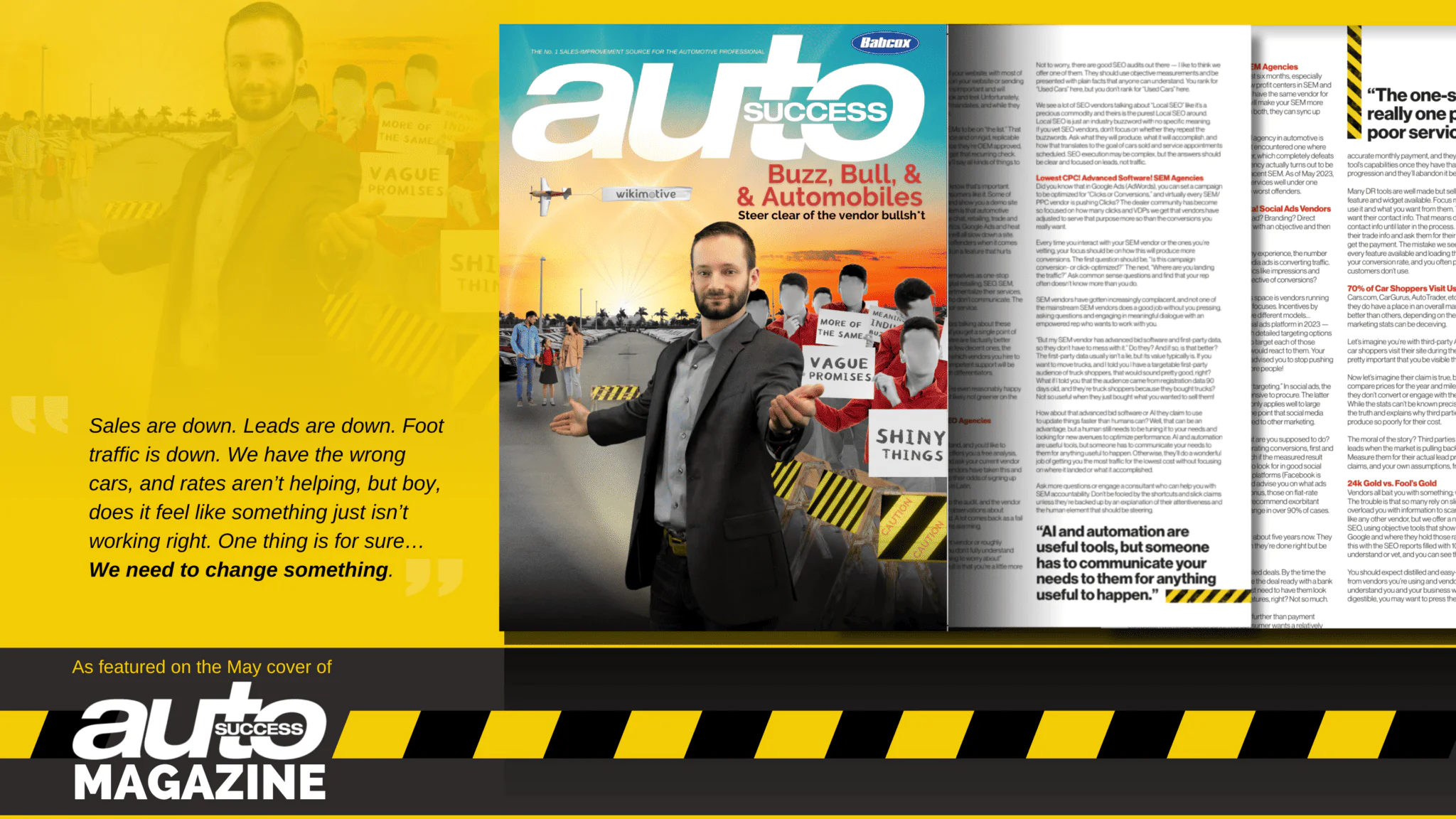
Today I’m joined by Zach Billings, CEO of Wikimotive. Zach has spent his entire career on one problem: getting dealers noticed online. He walks us through a major evolution in the SEO game dealers have been playing for decades, and how AI slop on dealership websites is actually killing their business.
There’s no silver bullet here, but there is a complete framework to turn around any dealership’s online visibility.
Welcome to the Car Dealership Guy podcast.
What Makes a Dealer Appear in AI Search
[Yossi] You first came on my radar when I had someone on X send me a DM, and they were telling me that their business has been growing and doing all these great things. And I said, okay. Well, what are you doing? What’s driving? And they were sort of bragging that they’re showing up first on ChadGPT. So I said, okay, how’d you do that? And they mentioned someone that works at your company and who was working with them and helping them out. I said, okay. So there’s something here.
I’ve heard about you, obviously. I mean, you’ve been around for over two decades. Wikimotive is a name I think most dealers have heard of. But that was when I said, okay, pause. What are they doing differently?
[Zach] So the counterintuitive answer is that nothing special. The discipline of AEO, which is answer engine optimization or GEO, generative engine optimization, doesn’t require anything special that a dealership shouldn’t already be doing before ChatGPT came along or Gemini or Claude.
The key to showing up in those things depends on prompt and what somebody put in, but if they looked for like best, you know, insert make here, dealer or best dealer near Fort Lauderdale, best Ford dealer near Fort Lauderdale, whatever the case might be, the first thing that’s going to come up is the dealer with the best reviews. That’s not even something that the vendor does for you. That’s not something we do for our dealers.
Your reviews come from how you treat your customers, what your process
[Yossi] So that’s, and you’re saying that’s driving…?
[Zach] That’s a major component of it. So the number one thing that’s gonna impact a dealer’s visibility in one of the AI platforms for a “best [brand] dealer” search is going to be their reviews. ChatGPT, Gemini, Claude, they all look for consensus. So when your reviews across all different platforms say these guys are great, we have a great experience with them, you get to the top when someone’s looking for the “best [brand] dealer”.
If on the other hand you have consistent things that come up in your reviews that are negative, that’s gonna suppress you. So that’s a huge part of the underlying method to show up in AI: to have great reviews, and that’s not something you pay a vendor for, that’s something that you do at grassroots level with your customers.
[Yossi] So while we’d like to think there’s this whole new science, it’s really a derivative of Google is what you’re telling me.
[Zach] Absolutely. Google and the other review platforms on the review side, but then moreover the other things that you could search. So we did a study at Wikimotive for instance, or we’re in the middle of doing a study I should say, it’s ongoing, where we’re looking at prompt visibility in ChatGPT for a range of dealers.
So let’s say the search might “be F-150s for sale under $50,000” and we’re looking at which dealers are showing up in the top cited positions in ChatGPT.And then we’re grading all of these different parameters. What website platform are they on? Was there inventory on the page that showed up? Was there content on the page? Was there schema markup on the page? Was there llms.txt on the page? All these buzzwords that people talk about when they’re trying to sell GEO or AEO as a product.
And what we’re finding time and time again is that the number one predictor of showing up for an inventory search is the dealer had content on the page, good quality content on the page. The number two predictor is that they had inventory on the page. And down at the very bottom of the list is all the things that everyone is usually talking about, schema markup and all this technical stuff.
[Yossi] So you’re saying content is driving the most AEO or SEO value?
[Zach] Both, And so fundamentally what it is, and the reason that you heard what you heard, was that when we’re focused for our dealers on doing great quality content that provides value to the end user, that simply makes the dealer in question the better answer.
And what is ChatGPT’s goal? Maintain market share, right? They’ve got Gemini and Claude nipping at their heels, and Gemini wants to gain market share, and Claude wants to gain market share. So all of them, it’s in their own vested interest to provide the best quality answer to whatever the prompt was.
How do you do that? Align the best content that was the most useful to the end user and the information you can draw out of that.
So great quality content is AEO
What “Good Content” Actually Means
[Yossi] So when you say good content, what does that really mean?I think there’s a lot of, I perceive like snake oil out there, right? We’ll do this for you and we’ll create that. But are people hiring an intern and that intern is just prompting an LLM and putting AI slop on my website? Is that good content? Like what is good content? How do you do that well?
[Zach] Well, the word “slop”, I love that this has become common because it’s right there in the word. Like slop doesn’t sound good and no, that’s not good quality content. It’s not that AI can’t write your content. Technically it can, but only if a human is doing enough of the steering. You need a lot of what we just say “human in the loop”.
So the criteria is this, and Google makes this very clear – and Google is still by far the dominant market share player between traditional search and AI search. Google makes it very clear that their expectation is that a piece of content that is considered to be valuable and therefore should show up simply needs to provide authentic legitimate value to the searcher.
[Yossi] So it can be written by AI?
[Zach] It could be, but only if there was a human who came up with how are we going to align this strategy? What do we even want to show up for? That’s the starting point. Then you need somebody to come up with what are the topics that need to be included in this to be useful to the end user? AI cannot intuit all of that on its own.
Then, when you’ve had the AI do the writing – if you’re gonna have AI do the writing, and I don’t necessarily suggest that but you can – then you need an editor to fact check it.
Sometimes, let’s say you’re writing about F-150 and you asked for a piece on 2026, but most of the information on the web was 2025 and and there’s not always a year associated, so when it’s drawing all of this information in to make your piece of content, it can get things wrong. Never mind hallucinations, which have become less of a problem over time. AI can just draw the wrong facts and pin them on the wrong part of the donkey, so to speak.
So what you end up with is a piece that was supposed to be on 2026 F-150 with a whole bunch of 2024-2025 stats in there, and you need an editor, a human, who can discern the difference to make sure that you get to a high quality piece that’s correct, accurate, and valuable to the end user.
Between strategy, alignment, facts, what’s useful to different people in that environment, that geographical environment, the use cases for an F-one hundred fifty, towing, work, luxury, you have to have a lot of “human in the loop” in order to provide that unique perspective. The other way that I would put it for everybody who’s like, but I just want to use AI to do the writing – and you can, but – imagine if everybody uses AI as their writer and it has the same information that it can pull from, same database, same information on the web, same criteria for thinking.
Everything just starts to look like an even shade of gray. So even if it’s not slop the way that people would often use that term, what you end up with is very lowest common denominator work, and even if that lowest common denominator has come up because AI was a decent force multiplier, you look the same as everybody else. So you still need something unique to make you stand out, and that’s what’s important about quality content generation and how it turns into a result.
Rankings Versus Dealership Outcomes
[Yossi] There’s no doubt that if I rank first on SEO, that’s just going to drive my business. And how are dealers capitalizing on that? Like, are they hiring interns in house? Are they working obviously with agencies like you? Are they and then are you using interns in house? Are you using SEO specialists? Like, how is everything being coordinated here for people to get this edge like that guy that DM’d me on X?
[Zach] So the first thing I want to do there is push back on the notion that ranking is the thing that is gonna drive success on its own, automatically. So great SEO can be great SEO aimed in the wrong direction. Say you’re a Chevy dealer and you write the world’s best piece of content, doesn’t matter if AI did it or a human did it, you write the world’s best piece of content on Silverado towing capacity.
When a consumer searches for that, they get results all over the country. That is a research keyword. It’s high-funnel, and Google understands that it’s high-funnel because they see how people behave when they search that. So the results are from all over the country. So if you write the world’s best blog article on silver auto towing capacity, you get a whole bunch of traffic to your website, but it won’t produce conversions. Look in those Google Analytics and you’ll see zip for conversions with thousands of visits to the page.
Yes, that’s position one ranking. Yes, that’s SEO.
No, it was not properly aligned to the outcome required. So the first thing I would push back on is the notion that getting rankings is the goal, getting outcomes is the goal. Then how do you get there and how do you get there consistently? How do you make sure that your work is aligned to where Google and also the AI ecosystem is going (to your question) you have humans doing the work. And you know at Wiki there are a lot of different disciplines that go into it.
And this is true of really anybody who does SEO at a professional level. You have professional SEO strategists who are people who have had to learn through a lot of trial and error. SEO is a little bit more of an art than say paid searches.
So, organic, you have to figure out how this piece of content generates the intended result, does it, and then you have to tweak it and iterate and maybe you rewrite it. Whereas paid search you just pay Google to show up for a particular keyword, you bid enough to outbid your competitors and you show up. So with SEO you need people who have been there and have learned from experience. I like to say it’s the SpaceX model. You have to fly the rocket and blow it up a bunch of times before you really know how it works.
How Wikimotive Produces Distinct Content
[Zach] And then you need editors. That’s a different person than an SEO.
[Yossi] Okay.
[Zach] You need writers. That can be a human or it can be an AI. In our case, we employ a team of US based writers, professional writers.
[Yossi] How many?
[Zach] We’re around fifty writers in the United States.
[Yossi] Fifty writers?
[Zach] Yes. Well, so the question I get a lot is you know, I’ll be talking to a Chevy dealer. We incidentally have more Chevy dealers than any other brand. And the question is how do you write a landing page about Silverado when you’ve already done that forty nine other times for your forty nine other Chevy dealers? Employ fifty writers. Have a different writer write every single page.
Unlike AI, no two human beings will run over the same thought patterns. They won’t have the same background information in their own mind, they won’t have the same creative way of thinking. And so we certainly give a lot of structure to our writers, so the SEO team is looking very carefully at how this dealer currently shows up for this very important keyword set in search? How are the competitors showing up? Why are the competitors showing up? There’s so many factors that you have to look at. But once you figure out, all right, we need to show up for this, and here’s what it’s gonna take to get there in terms of topics or volume of content, and we won’t get too technical here, but you align that, you build the structure of an outline, but then you give it to a human writer and you let them inject their human creativity and experience into that.
And by doing that and making sure that no two pieces are written by the same writer on the same topic at the same time, you avoid having redundant content. Because the last thing we would ever wanna do is take two landing pages about Silverado for sale, put them up on two different Chevy dealers websites and have them be almost carbon copies with just some different phrasing because Google looks at those and then they say, those are the same thing. They didn’t provide unique value”. The only way to have unique value is to be truly unique and farming it out to fifty different writers is the way.
[Yossi] And there is like what level of variance are you seeing here, right? Is it five percent different, ten percent, fifty percent? Because ultimately I wanna retain my edge as a dealer.
[Zach] Yeah. Right?
[Yossi] I don’t want my copy to blend with the rest of the stuff, whether it’s six months later or twelve months later. So how different do you actually, like what’s your target when you meet with all these writers and you give them guardrails? How different are you really looking for?
[Zach] Substantially. We build a dossier on every one of our dealers. So it starts there and a dossier would be filled with model priorities, lease versus purchase priorities, you know, what is their lease penetration in their market? Is it service priority, used car priority, CPO? You know, we’re understanding what the business objectives are.
From there we understand market objectives. We look at pump in, out reports, we look at what are competitors doing specifically in the SEO space, assuming we’re talking about SEO here, and we develop an understanding of what the dealer needs and where the hurdles are and where we need to gain fresh market share. That’s a dossier, or the basics of it.
We also learn about the dealers unique value proposition points and what makes them different in their marketplace, how they serve their customer base differently. We want to be able to produce content as best we can in their brand voice. So there’s a questionnaire that goes out, our performance managers work carefully with our dealers on that, and first of all, all of that content at the end of the day needs to be aligned to the information in that dossier so that it’s hitting the dealership’s outcome objectives, If we’re aimed in the wrong direction, they’re not going to be more profitable as a result of the work.
[Yossi] Correct. Even if you do, even if you’re a Chevy dealer and you cover every Chevy recall and every single consumer who’s researching about those recalls, they’re not going to buy from you. That’s essentially what you’re saying.
[Zach] Correct.
[Yossi] So you’re going to show a spike on their website, but that’s not going to convert into sales.
[Zach] Metrics do not always mean outcomes. You can get tons of traffic and if it doesn’t produce leads, it does not impact the dealer’s opportunity to sell and service cars. Therefore it does not impact profitability. There’s no ROI on the service, right? So you have to make sure you’re aligned to dealership objectives. And then to your question about how different the writing should be, well first of all we’re starting from a unique snowflake individual dossier, right, that is specific to that dealer’s environment, needs, and voice, so already you’re going to start from a great basis of differentiation. And then we pass it through plagiarism checks, through AI writing checks, because if they took a shortcut and not enough work went into it, that can actually be detrimental.And at the end of the day, I would say the piece is 100% unique.
Could there be outlining similarities in terms of we want to cover new, want to cover used, we want to cover value proposition points, we want to cover service?
[Yossi] Got it. But does any brand, is there any brand out there that has some, you know, innate advantage in this AI world when it comes to showing up first on searches?
[Zach] No, not inherently. In the AI space, the edge you get is unique to your own dealership circumstances, if an edge is even possible.
[Yossi] To your own specific dealership product.
[Zach] Yeah, so inventory volume gives you an edge, that’s true of SEO as well. A great reputation gives you an edge – that’s true of SEO as well. Great content gives you an edge – true of SEO as well. But the brand inherently, the make, doesn’t do anything. It doesn’t have any influence one way or the other.
Inventory, Dealer Groups, and Search Visibility
[Yossi] I had a dealer (Eddie Stivers) on the podcast recently and he was talking about how he’s consolidating his dealership around one brand, Ford in this case. And for many reasons, he’s looking at our efficiencies, operating leverage, and many other reasons. But one of the reasons he did point out, I said, hey, his thesis is that he will also be the leader, the AI leader in that region from like a SEO perspective, know, visibility, search visibility perspective, because he will have, you know, the most mass in that in the specific region. If he has four or five Ford stores, he’s showing up first. That was at least his thesis. What do you think about that?
[Zach] I agree – and that extends beyond AI to the much larger available market share, is still traditional search. Literally ninety nine percent of the available market share for low funnel dealership opportunities is from traditional search, not AI search at this point, but it’s evolving. Either way we slice that, I think he’s correct in premise.
If you have the majority of the Ford stores in a region – first of all when you ask “best Ford dealer” your general managers might not all be happy about it because they might be kind of internally competing, but as owner of all of the four dealerships in a region, you’ve got the advantage, right? Because you’re gonna naturally be the one that’s gonna show up most prominently. Moreover, when you have a dealer group, be it the same brand or not, same make or not, you can pull your inventory, and you should.
More inventory is a huge lever when it comes to AI search, when it comes to traditional search, and it makes sense because when someone types in F-one hundred fifty for sale near me, well the entity with the most F-150s is the most logical choice independent of like if you have better content, etcetera. So if you can pool all your F-150s on all of your websites, all of them have an advantage.
And this is why groups often win sort of by default, because they have so much inventory that they can just outweigh a single point dealership in terms of opportunity to be able to show up in searches.
Whether Dealers Need a Dedicated AI Search Vendor
[Yossi] A lot of the solutions here are not some new sexy thing. It’s like having more inventory, write more relevant content. It seems like it’s very basic. And again, I’ve seen a lot of new stuff out there that’s unclear if this is really effective stuff. I also wonder who will be the best partner to work with when it comes to winning in this AI search world. Is it a new company that is strictly focused on AI search, but has no other advantages, no other piping in their business? Or is it an existing agency that already has all the other piping and bolts on AI search? Not being a practitioner like you, I could make a case for both.
[Zach] Sure.
[Yossi] What’s your take on that?
[Zach] The first thing I would say is the idea that we need to show up in AI search, we need to get on top of this new emerging space, I totally understand where that comes from.
There is an evolution, some think a revolution, I would say it’s definitely an evolution happening under our feet. And the last thing we wanna do is get left behind. So everyone is maneuvering and trying to crack the code for how we show up in this space, but many times we’re not pausing to look and see how many people are using, how many consumers are using this space to try to find dealerships and products versus doing their research, high funnel. That’s the first issue, and that’s, it’s a much more linear, much more steady growth than people assume.
[Yossi] So you’re not falling behind?
[Zach] Dealers in general are not falling behind any more than they would have been anyway based on whatever else they were doing. So if you’re behind in SEO, you’re behind in AI search too.
[Yossi] Got it.
[Zach] But you’re not falling behind if you’re not pivoting towards AI search. It doesn’t work that way. So, to your question, the best solution for you is to go, I mean you said the word basic, back to basics. It’s aligned with solutions that are tried and true, that produce value for the end user, because ultimately that’s what serves all of the possible areas.
I’m not gonna say that a newcomer to the space couldn’t do a great job. A new company could spring up and absolutely do a great job of helping with AEO, GEO, but if that’s the sole focus, they’re only gonna be vying for 1% of consumer market share that dealerships can buy for. The other ninety nine percent is still in traditional search paid and
[Yossi] Yeah, so you’re putting this like disproportionate focus on something that’s still a very small piece of the pie.
[Zach] Correct.
[Yossi] Got it.
Google Business Profile and Local Results
[Yossi] Now when you say AI search or any search, do we have any differentiation here between Google My Business? Like if I right now, if anyone here pulls out their phone, goes on Google, and writes “Ford store near me” you’re gonna see all the sponsored ads, SEM, which we’ll talk about soon. You’ll then I think you’ll see the [Google Business Profile], where you’ll see actual local listings. And then you’ll see SEO. I think this is a great structure today. Is showing up first on those local listings, is it the same inputs as showing up first on SEO, or is it different inputs for me to be first there?
[Zach] They’re different.
[Yossi] They’re different.
[Zach] Yes, there are overlaps for sure. So first of all, your reputation is going to be a component. Your on-site SEO, as in like the content on your website, can be a factor that sort of feeds authority back to that local pack, the map pack, the Google Business Profile part.
But here’s the big thing, a lot of dealers have been sold the notion of local SEO on the basis of I’m gonna get, you know, I the vendor, I’m gonna get a dealer to go from position three in that map pack up to position one in that map pack. And that is unfortunately not a realistic objective.
[Yossi] It’s not?
[Zach] No.
[Yossi] There’s no lever to make that happen or
[Zach] Location.
[Yossi] Location?
[Zach] So unless you’re to move your store physically closer to where that person was standing, you’re not going to materially change your position.
Now there are some ways that you can handicap yourself that you don’t want to. If you don’t have your [Google Business Profile] platform profile set up completely, so if you haven’t filled out your categories, if you have missing information, if you have wrong hours. That’ll penalize you. You’re certainly gonna handicap yourself doing that.
But assuming all of that’s filled in, which is mostly table stakes these days, it’s gonna be location as the primary ranking factor for that three pack. So if a consumer is on their phone and they type in “Ford dealers near me”, the closest Ford dealer will generally be first, second closest second, third closest third. We all know this intuitively because when we’re somewhere that we’re not familiar with and we put in “Italian restaurant near me”, you get the closest one first. When you’re at an Airbnb on vacation and you need to find a Target and you just type in Target, you get the closest one first, you get the second closest one second, and we forget all these same principles that we’re used to experiencing in our personal lives outside of our business apply to consumers who are looking for a car dealership.
Paid Search, Performance Max, and Vehicle Ads
[Yossi] Is search engine marketing, Google paid ads, is that going away, is that dying, where are we at?
[Zach] Not at all. Not at all. It’s becoming more wasteful. I see much worse implementations of it much more frequently than we used to.
[Yossi] How is that even possible in this age of CDPs where everyone is spending all this money on a customer data platform? Isn’t that the whole point of a CDP?
[Zach] So you take a CDP and you deploy first party marketing via email to your existing people or text message, great. Wonderful use case for CDP.
Trying to deploy that using first party audiences into paid search: doable, but not the primary way that most people are able to end up leveraging paid search and doesn’t necessarily apply in all cases. Paid search is still in many ways very simple. Someone types in “Ford dealers near me”, you can show up organically, you can show up in the map pack, you can show up in the paid search positions and you’re bidding for real estate. You are willing to pay for one of the three or four paid search positions and to show up there you’re gonna get some clicks that you wouldn’t have gotten if you weren’t there. So is paid search going away? Absolutely not.
Alphabet, Google’s parent company made more than half their money last year from Google paid search. It’s not gonna go away. AI is not killing it either because the AI platforms don’t always align to these low funnel searches. They don’t do a very good job returning results that well for them. So you’re still going to have people searching Google, and it still makes sense to use paid search.
Why is it becoming more wasteful? Because there’s more and more and more reliance on automation, Google’s own automation being the worst offender. So Performance Max campaigns, P Max campaigns.
[Yossi] No good.
[Zach] No good. Everyone’s heard about them, most people have a positive impression of them and for an understandable reason. It’s in the name, Performance Max…they are designed to maximize performance.
For anyone not familiar, Performance Max campaigns are basically Google holds out a bucket and they say drop some money in the bucket and in return we will give you your intended outcome. Hopefully leads.
[Yossi] Yeah.
[Zach] That happens.
[Yossi] Sort of like Facebook marketing?
[Zach] More targeted than Facebook marketing. Facebook marketing is more of a shotgun approach – catch somebody while they’re on the toilet scrolling. And Google is more like we’re gonna put some people on VDPs, we’re gonna drive them to your website for the keywords that you should care about.
But here’s the problem, if you’re John Smith Chevrolet and you put money in the PMax bucket, Google says well what’s the cheapest way I could get John Smith Chevrolet leads?
Just show up for “John Smith Chevrolet”. When someone Googles “John Smith Chevrolet”, they’re definitely gonna submit a lead because they were clearly looking for that dealership.
Here’s the problem. Now a bunch of your PMax budget is bidding on your own name.
[Yossi] So you’re saying a branded campaign is included in P Max?
[Zach] Baked in. And very hard to carve out without completely applying a negative for your whole name across your entire Google Ads campaign set, everything, and the result of that is you have to go kind of all or nothing dealers.
Dealers spend money with a vendor, right? Wikimotive, you know, we charge a flat rate for paid search. Some vendors charge a flat rate, some charge a percentage of spend. No matter what, you’re paying money to have a vendor operate the paid search on your behalf.
What are you paying for?
You’re paying for somebody who’s supposedly an expert to curate campaigns that are going to be the best performing for you. If your vendor is just throwing all that money in Google’s automation bucket and they’re not doing the work, what are you paying the vendor for?
PMax campaigns were built for mom and pop / corner stores that can’t afford an ad agency to be able to deploy their own paid search with reasonable efficiency. They weren’t built for car dealerships that pay vendors thousands of dollars a month to manage their campaigns.
And I would argue that it’s not only lazy, but also wasteful.
[Yossi] Wow. So what is the most effective Google campaign type nowadays? Like how do you structure that well?
[Zach] So having campaigns around your, you know, I talked before about the dossier, right? Understanding the dealership’s priorities in terms of sales and service, understanding target geographies and carefully tuning to that. So for starters, traditional campaigns like I want to show up for Ford dealer keywords because I’m a Ford dealer, that makes sense, fine-tuned to make sure it doesn’t include your store’s name and fine tuned to make sure that it’s reflective of your pump in, out report, plus up your budget in places where you’re soft, for instance.
And the other side of that is I get a lot of questions about vehicle listing ads or vehicle ads dying? Are they becoming less efficient? The answer is kind of yes because Google’s running out of inventory, ad inventory, not as in car inventory, as in places to put ads.
[Yossi] Yeah, it can only show so many and get clicks.
[Zach] So you’re getting into less and less efficient spaces sometimes, and that’s why the efficiency of those has gone down some, but they’re not dying.
[Yossi] From the VLAs?
[Zach] VLAs, yep. There’s still a good way to go, and they do run through the Performance Max system technically, but I would say for a small dealership with a limited budget for paid search, vehicle listing ads are actually the way to go, assuming sales are your objective. They land people straight on VDPs. They’re very specific, it’s a smart way.
Following Outcomes Across Marketing Channels
[Yossi] You have this line, “be unromantic about marketing, follow the opportunity”. What’s the opportunity?
[Zach] Let’s start with “being unromantic” because that informs the rest. And we all need to be unromantic about our decisions around marketing, not having sacred cows that we refuse to kill.
We were born doing SEO. That was where we came from in auto retail, when we started the company – McCluskey Chevrolet, our first client seventeen years ago, is still a client today _ they hired us to do SEO.
And so we did this for the longest time and for many many years we said paid search was bad, organic search good, because we were romantic about SEO. As time went on, we broke that mold, and we started saying don’t fall in love with SEO, don’t fall in love with SEM, don’t fall in love with the notion of showing up in AI.
Fall in love with the notion of producing outcomes.
[Yossi] Getting leads, closing sales.
[Zach] It’s that simple. At the end of the day, we hire marketing solutions to have more business opportunities as a dealership, and all marketing needs to lead to more opportunities.
So where do you go today? You can definitely rack and stack in a broad sense which channels, which marketing channels produce most consistently when done properly, but they require some more careful measurement for the outcomes. SEO compounds its gains over time, and what I mean by that is if you’re doing SEO properly and it’s producing outcomes, you can pay the same amount of money internally to your staff or externally to a vendor, every month ongoing forever. And every month you’ll produce more outcomes than you produced the prior month.
[Yossi] Because you’re creating more content.
[Zach] Correct.
[Yossi] You’re There’s no limit though, you’re saying. You can just keep…
[Zach] I mean, we’ve been doing it for seventeen years for one dealer and it continues to climb.
[Yossi] But will my content from 2015 still benefit me today?
[Zach] Some of it will, some of it won’t. If you had like a 2015 Silverado page, that’s now a used car page. That’s still relevant as long as it was adjusted to reflect that it’s used car content, not new car content. If you have a piece of content that’s supposed to represent the Chevy model lineup from 2015 and you didn’t update that, now that’s stale.
[Yossi] So is there a way to write content in a way that extends its shelf life?
[Zach] The term would be evergreen.
[Yossi] Evergreen, yeah.
[Zach] You do try to write content that’s going to remain relevant as long as possible, but there’s a point at which you become generic if you try to do that too myopically.
[Yossi] Makes sense.
[Zach] Right, so you have to balance that. There’s gonna be pieces of content that can live happily for two years without needing to be rewritten or refreshed. There’s pieces of content that need a refresh once a year and you have to know the difference and you have to go back and readdress that at the proper cadence. SEO when done properly compounds in gains. SEM, very efficient when it’s being used tactically and you’re aiming at what’s going to align to your dealership’s needs. Paid social can be effective, but you have to understand it’s kind of a shotgun approach.
At the end of the day, using analytics, it’s not sexy, but using analytics to measure the volume of outcomes you’re getting from these sources, that’s your decision matrix. If you have too high a cost per sale, too high a cost per lead across the dealership, and you’re trying to figure out where do I trim, where do I reinvest to be more efficient with my marketing, you need to identify at a channel level, organic, paid, paid search, paid social, etcetera, what your outcomes look like, and then figure out how to shift that around.
Consistency, Experimentation, and Dealer Fundamentals
[Yossi] Do you think that in 2026-2027, other than having a great unique writer on the SEO side, is there an actual edge to be gained? Or is this just like baseline table stakes?
[Zach] The edge is not a quick fix. When we say edge, often dealers I talk to, most of the dealers we talk to, looking for something that they can they can find that nugget that no one else has found and crack it open early, leverage that early, and get an early bird gets the worm advantage or something that no one else has thought to do.
Will those always exist in some way or another? But the most sustainable way to get an edge is the dealership process, it’s a great reputation, it’s underpinning all of your other efforts with the best way to make customers happy and to convert them efficiently so that your marketing is able to return the most per dollar out.
And beyond that, it’s avoiding excessive distraction. Because look, this is automotive and you know, we’re always chasing the shiny thing, we’re always chasing the new hotness.
[Yossi] Even though I’m doing it right now.
[Zach] Sure, sure. We’re talking about AI.
[Yossi] I’m such a marketer, like I can’t help but wonder, you know, where is today’s edge?
[Zach] You tell me, do you think that dealers today are as focused on the store level fundamentals process as they were pre COVID?
[Yossi] Think it depends on the dealer. I think that in large part there are a lot more distractions and you have to just simply do a lot more. Think about a dealer today versus a dealer even ten years ago. Today, you have to be like a, you know, tech specialist and you’re half your day, you’re managing vendors. I mean, some of the most successful dealers in this country, and I guess this is sort of paradox in a way or so ironic, but like they’re constantly asking me about this tech vendor, that tech vendor, they’re doing a demo there. And I’m like, “you’re spending so much time vetting out tech.Where’s the time to actually be in the dealership?”
Now look, they’ve teams and all that. But the point is they spend a very large amount of time on just finding the next solution because everyone wants to operate more efficiently, reduce their cost of sales and, you know, capture more gross, preserve more margin, whatever.
So, I think it’s a lot tougher to be focused on the right things today because you have a lot more opportunity for distraction with everything being thrown at you at once and a lot of it is valid. You do need to consider using this AI tool to capture your overnight phone calls because you are missing sales. But yeah, I think it’s a lot easier to be distracted nowadays.
[Zach] I think it’s a case of “yes, and…” is what makes the most successful dealers. Most successful dealers I can think of. McCluskey Chevrolet is a great example, went from two hundred cars to one thousand cars over the course of, you know, a decade. But great marketing’s a part of that, but consistency is one of the greatest superpowers that Keith McCluskey has.
[Yossi] And you’re an amplifier.
[Zach] An amplifier, a humble amplifier – with consistency, with compounding gains, with the focus on quality, but the store process and the ability to stay consistent, to not shift vendors every five seconds is a superpower.
“Yes, and…” means you also need to experiment with emerging technologies, but you don’t just throw the baby out with the bathwater when you’re doing that. I have copious examples of dealers who have a burning drive to find that next edge, that next thing that they can crack open to be able to be more successful, true kind of entrepreneurial spirited dealers.
[Yossi] Yeah, that’s my problem.
[Zach] Dealers who don’t change their entire ecosystem every five seconds because new and emerging things come out. They test in the background, it’s yes and. It’s to do the basics, stick to the fundamentals, focus on process, focus on people, focus on great quality marketing, and also experiment with new technologies. Learn what works, learn what doesn’t, trim, prune where
[Yossi] Have like an experimental budget, not from a financial perspective, also that, but from an actual time allocation. Keep a certain amount of time on your calendar, constantly just experiment, try new things and see how they operate.
If you look at some of your boldest dealers, I don’t want to say average dealer because no one wants average, but if you look at some of your boldest dealers, what does their marketing mix look like?
[Zach] I’ll go to DePaula Ford. Jay Newell’s one of the operators I was just thinking about, talking about people who are consistent and steady, and he’s 2x’d his sales, 5x’d his net in seven years, okay?
The totality of his marketing mix dabbles into some traditional – he’s diversified in a handful of areas – but the core is search. And we only do one part of his search and you know I think good vendors should collaborate with other vendors when there’s a positive push pull that can happen there. But his SEM SEO mix, for instance, is not far from 1:1. Most dealers are about 10:1, where ten to one SEM versus SEO.
[Yossi] Correct, right.
[Zach] If you’ve got a $10,000 SEM budget, you’re spending $1,000 on SEO.
[Yossi] So is he under-investing in SEM or is he over-investing on SEO?
[Zach] No, he’s balanced really well. So he’s probably like 1.5:1. And that is he has a properly funded SEM side, and he’s spending more on SEO than most people
[Yossi] Most dealers. Got it.
[Zach] Think they are supposed to, because we operate in an environment where the sort of the cost tolerance for SEO just goes back to forever ago when the first website vendors had sort of a cookie cutter, tick the box SEO line item, and at the time that was just like injection of like some city names into their technical SEO. There was no human work being done and it was also a small enough line item that no dealers blinked an eye. You just turned it on because that got you covered and that’s kind of kept this, that has created the cost tolerance perspective and what it is so you end up with a mix that’s just out of whack.
Jay Newell is also a guy that will run fire drills with his vendors on a regular basis in a great way, and what I mean by that is he inspects what he expects very carefully. He’s plugged into his people and his operations at the store level. He pulls his weight there and when something’s not going right, whether it’s something in his analytics, something in a report, he’s at a 20 Group meeting and something’s off in terms of composites that wasn’t off last month, He’s hitting up the vendor in question and wants to know what’s going on here, but what he doesn’t do to the larger line of questioning here is change vendors with the changing of the wind. He looks for why.
[Yossi] Yeah.
[Zach] How do I understand why the outcomes are changing? Did the outcome change? So great for instance, that he came back from a 20 Group meeting, this is relevant to us, and what we do for him, he came back from a 20 Group meeting and his organic traffic had decreased. He had been the leader in his 20 Group composite in organic traffic for a while, he came back and was like, “Zach, what’s going on with the traffic? I’ve been number one in my composite for forever and now I’m not.”
And that’s a fire drill, right? A well reasoned fire drill. And so we dug in and we looked at why is that? Well, back to something we were saying earlier, right? You’ve got your research topics and you’ve got your low funnel topics. There’s landing pages and SRP content, all the stuff that drives conversion outcomes. Then you’ve got your blog articles. That sort of they’re table stakes, they’re part of a larger strategy, but they also have a tendency to bring in traffic from outside of the market, traffic that’s high funnel.
And you know what AI has done? It has intercepted a large amount of research traffic.
Why do you need to go to a dealership’s website to learn about F-150 fifty towing capacity? You don’t. You just read about that in ChatGPT or in the AI overview on Google. So the traffic that had been lost was the traffic that was not converting. That’s okay.
So, when we looked at it much more closely, conversions had gone up, outcomes had gone up, low funnel traffic had gone up, high funnel traffic had come down, the metrics were not aligned to the outcomes.
Smart operators like Jay ask critical questions, they learn what’s actually going on, they become a student of those details, willing to get their hands a little dirty in analytics and understanding outcomes, and then they make informed decisions on that basis.
[Yossi] Wow.
[Zach] 5x net in seven years.
[Yossi] Incredible.
Measuring the Partnership and Wikimotive’s Approach
[Zach] One of our favorite things to do is be proactively accountable to our dealers and to focus on outcomes. One of the greatest prides in my career is being somebody who we want to bring outcome forward conversations to every meeting and truly have our vendors or sorry our dealers equipped to be able to ask critical questions.
And when something’s not going right, it’s a lot better. It’s a lot better as a partnership to go to somebody and say, I see something’s off. Either here’s why, it’s not a concern, or I see something off and here’s what we’re gonna do about it, let’s make a pivot.
And it’s core to our business model because that’s how you build partnerships as opposed to the typical vendor dealer relationship where you’re on the other side of the table and kind of everyone’s always doing the, you know, Spider Man circle thing.
[Yossi] So, before we wrap up, here’s how I look at you right now. Right? You mentioned a lot about consistency. You’ve been consistent yourself. You’ve been doing this for over two decades. How? Like, that’s a long time to be at the game and reinventing the company and, you know, let alone every year you got to reinvent. Like what’s been driving you?
[Zach] We just went through this great exercise at the company and we took who we are, what we are, what we’ve always been, and we did an all-staff / all-hands exercise to reestablish from scratch our mission statement for the company.
And ultimately, in nutshell here, Wikimotive’s mission statement has always been about outcomes and accountability, and the outcomes are dealer outcomes, not our bottom line outcomes. We’re not P- funded, we’re a bootstrapped company, and that’s great because we’ve been able to stay the course the entire time rather than focusing on grow, grow, grow.
And ultimately the answer to your question is how do we stay consistent?
We are aligned to dealer outcomes for our partners, for our dealer partners, not one romantic thing in marketing. So as the ecosystem changes, as search evolves, as different marketing has come in and out of focus over the years, we have simply continued to iterate, even prune.
Just finished a couple weeks ago off boarding our last couple of dealers from our old legacy organic Facebook management product. Once upon a time we did organic Facebook management for our dealers, and we identified over time that that was not producing demonstrable ROI and the dealerships needed to take that in house. So we have pruned that over the years because we’re only aligning to what can drive dealer outcomes. How do we stay excited about it?
It’s a constantly evolving ecosystem, so it’s exciting to always be looking for the next ways that we can figure out how to crack that code and bring something new, but it’s “yes, and…”
[Yossi] It’s funny because I was gonna do a lightning round with you and be like billboards, you know, newspaper, radio, but I already know the answer is it’s like it’s not binary. It depends. Depends on the market. Depends on what they are putting on. And I agree. I mean, these things are very subjective. So I’m going to avoid that unless there’s any specific, you know, medium that you’re very passionate about that you want to call out.
[Zach] I mean Performance Max? Not your friend.
[Yossi] Avoid.
[Zach] SEO? not your friend in many cases because if you’re paying for SEO and you’re getting cookie cutter work, it’s actually flushed money and you should be reallocating that to just paid search or something. Don’t pay for bad SEO. We’re not the only ones that do good SEO, but it has to be the good stuff. It has to be outcomes and that’s how to measure. And that’s all I would say is not an individual thing, measure your outcomes.
[Yossi] I really like what you stand for and how you operate the company. It’s no wonder you’ve been successful. Zach Billings of Wikimotive. Zach, thanks so much for joining me. This has been amazing.
[Zach] Thanks, Yossi.