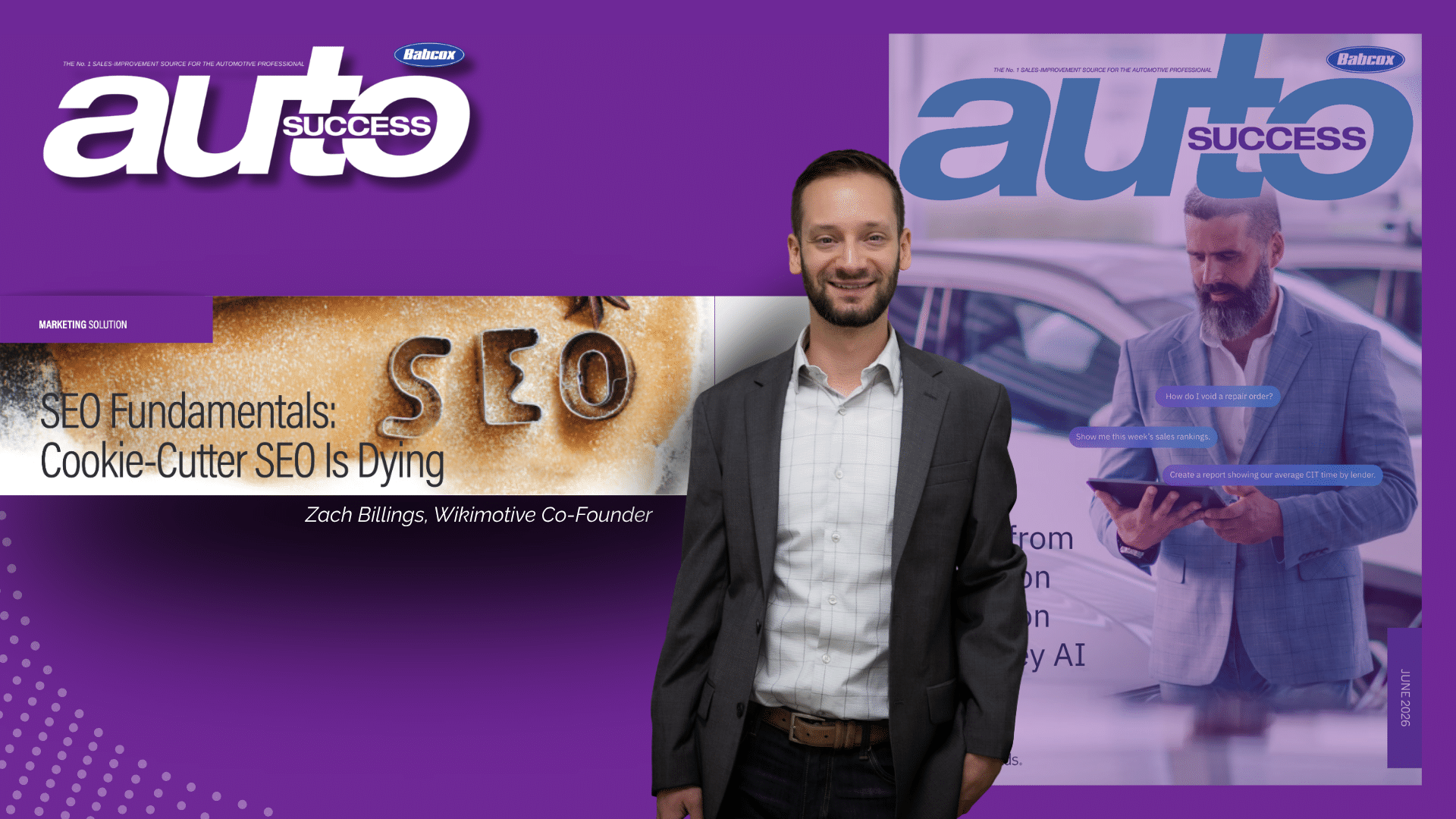
SEO Fundamentals: Cookie-Cutter SEO Is Dying
By Zach Billings, Wikimotive Co-Founder & CEO
Originally published in the June article of AutoSuccess Magazine
Search Engine Optimization (SEO) for organic Google, Bing and now even AI search visibility is often thought of as a tired topic in automotive marketing. Important, yes, but also static — an area of marketing that’s no longer changing or evolving, making the vendor solutions that service it a simple commodity.
I understand where that belief comes from, but it’s currently costing dealers not just the $2-3k per month they spend on SEO, but potentially hundreds of thousands per month in unrealized opportunity and gross profit.
In reality, SEO is still one of the fastest-evolving areas of digital marketing, and its practices are as much art as they are proven science. Today’s SEO landscape requires constant testing, iteration, and labor-intensive execution to determine what will rank above your competition and what will keep you there. Anyone telling you that you just need some technical SEO and some “keywords on the page” is selling snake oil.
So, in this article, I’m going to give you a 2026 refresher on what empirical studies and experts outside the automotive industry know about what Google responds to — and what it increasingly filters out.
Opinions Don’t Belong in SEO
Google generally responds well to genuine human expertise in website content — in fact, it explicitly looks for it through what it calls E-E-A-T: Experience, Expertise, Authority and Trustworthiness.
What Google does not respond well to is the half-baked opinions and recycled SEO theory that many dealers are paying for through cookie-cutter SEO packages. This isn’t a marketing line for Wikimotive, and I’ll prove it.
Open a browser and Google “Search Evaluator Guidelines.” Google publishes a 36-page PDF explaining how evaluators use the much larger 182-page “Google Search Quality Evaluator Guidelines” — effectively the public blueprint for what Google considers high-quality search content.
The Guidelines have received 12 major revisions since their first public release in 2015, evolving alongside Google’s refinements in what it values and what it wants filtered out of search results.
The focus of the two most recent major updates — January and November 2025 — should get every dealer’s attention: content spam and scaled low-quality content. Section 4.6 of the Guidelines explicitly addresses “scaled content abuse,” including content generated at scale with little originality or added value.
In plain English: Google is actively targeting mass-produced AI content and generic SEO filler.
Dealers relying on AI-written pages, recycled blog posts and automated “SEO content” should pay very close attention. Google increasingly expects genuinely useful, differentiated content written for human consumers — not content generated simply to fill space and target keywords.
- No copying content from the OEM.
- No duplicating another dealer’s pages.
- No recycled FAQ libraries.
- No thin AI-generated filler written solely to manipulate rankings.
The labor required to create genuinely differentiated, locally relevant, expert-level content simply costs more than the $2-3k/mo the industry has historically tolerated.
The Table Stakes
The concepts you hear about most from vendors offering SEO — technical SEO, updating your Google listing and citations, website platforms, and unique vehicle descriptions — all matter, but most of them are table stakes.
Website structure and Core Web Vitals matter, but most mainstream automotive website platforms are heavily constrained by scale, OEM requirements and templated infrastructure. Technical SEO matters, but primarily because it enables Google’s understanding of the content built on top of it.
The truth is that most of what’s being sold as “SEO” in automotive today is foundational support work — important, yes, but rarely a competitive differentiator on its own.
Content is still the differentiator.
No Special Sauce
Real SEO in 2026 is actually much simpler in concept than the industry often makes it sound. It’s also far more labor-intensive in execution than what’s typical from one-stop-shop vendors and ad agencies in automotive.
There is no secret loophole, no proprietary trick, no automation shortcut replacing strategic human execution.
Google’s ranking factors are broadly known and established. The challenge is the consistency, expertise and effort required to execute at a high level over time.
That means building genuinely useful, locally relevant, human-written content for shoppers actively looking for dealerships and inventory in your market.
Too many vendors focus on rankings, impressions and traffic graphs, when the actual scoreboard should be:
- Leads
- Calls
- Chats
- Trade leads
- Service appointments
SEO done right should measurably increase those outcomes over time. If it doesn’t, then the rankings and traffic reports are largely noise.
The stores winning organic search in 2026 are not gaming Google; they’re simply willing to invest in the hard work their competitors won’t.
If you’re not sure if you’re getting that today, reach out to Wikimotive for an SEO audit. You’ll learn something in the meeting, and you don’t have to take a pitch.