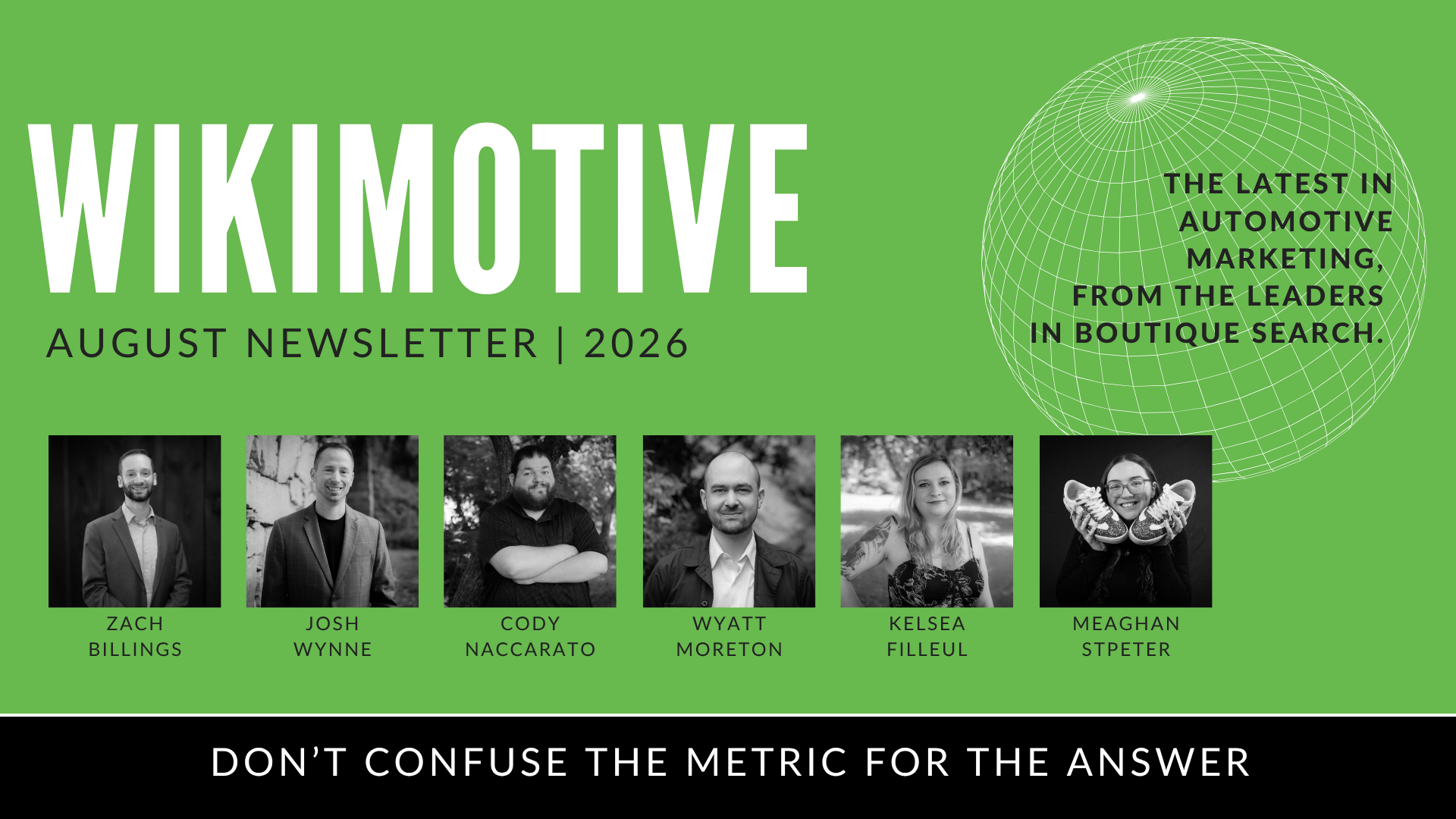
Don’t Confuse the Metric for the Answer
This Month from Wikimotive…
Six articles. Six different topics. One common thread:
What looks like the answer is often only part of the equation.

Your Marketing Math is Wrong.
By Zach Billings
Your 20 Group is doing a composite, measuring marketing cost per session, cost per lead, and cost per sale. The goal is $300. The average is $420. You’re at $550.
Time to fire a vendor or cut some spend, right?
Maybe. But if cost per sale and your sales stats are all you’re using to make that decision, you have no clue whether you’re making the right choice.
Start With Traffic: Website sessions are not all equal. 500 sessions from paid social might produce one lead, while 100 sessions from low-funnel organic search could produce 10. Traffic is a meaningless number until you establish quality, and the real test of quality is whether that traffic is converting into leads.
Then Look at the Cost per Lead: The primary job of your marketing is to produce opportunities. SEO, SEM, paid social, third parties, email—even direct mail—can all be measured to determine what is actually producing leads. That information exists, but your CRM does NOT contain all of it. You absolutely must use analytics to understand which channels and vendors are creating opportunities.
Finally, There’s Cost per Sale: Sales are the goal, but even good leads do not directly correlate to sales. Slow response times, poor communication, mishandled leads, unanswered phones, and other process holes can turn good marketing into bad sales results. Seasonality and market conditions matter too.
There is a healthy range for cost per sale. Too low, and you’re likely leaving opportunities on the table. Too high, and something is inefficient.
But cost per sale won’t tell you what is inefficient.
Cost per ______ tells you nothing alone. Before leveling the shotgun at your least favorite—or least understood—vendor, measure the individual channels, understand the variables, and make sure you know what’s actually working.

You Can’t Measure What You Keep Resetting
By Josh Wynne
Success cannot be measured in days and weeks, and strategically significant marketing decisions appear more clearly to those who understand the art of patience and deep analysis.
Stop Pulling the Plug
In automotive, we are sometimes so plugged into how things feel on the ground that strategy gets changed (often mid-campaign). As a result, digital marketing platforms like Google Ads, Facebook, and others often do not have enough time to establish a defined audience before the plug is pulled and then repeated in a different iteration.
This becomes especially concerning when it occurs frequently and develops into a recurring pattern. Read on to explore a better approach.
Give the Data Time to Work
It’s important to know that first-party data is the highest converting audience that your digital marketing includes, and sitting with a given marketing initiative for at least 30 days or even better, 60 days, can allow for better strategic outcomes in the showroom and beyond.
Unpacked further: the ability to analyze a complete campaign for 30 days allows the audience learning period to be completed. In the best-case scenario, dealers would allow for a 60-day campaign window so that performance can be measured against itself with the established audience included.
The 30-Day Trap
That longer learning window can conflict with the month-to-month rhythm of automotive marketing. When campaigns are reconfigured too frequently to accommodate changing incentives, audience learning may be interrupted before enough consistent data has accumulated to guide the next decision.
This is easier said than done, and especially so, since most OEM’s recharge incentives each month, which forces dealers to operate in this cadence if campaigns are heavily incentive-based.
There is nothing wrong with this approach if a solid foundation is already laid in other dealer-driven campaigns, but following the herd in 30-day chunks forcibly ensures you are competing with the very brand you sell, while also never getting more than a 30-day window of audience data before a reconfiguration occurs.
Don’t Just Follow the Herd
For many dealers, this cycle continues month after month with no clear endpoint. What they may not realize is that operating outside the herd can create opportunities their competitors overlook. Incentives can be valuable, but not when supporting them means doing the OEM’s marketing work while driving up the dealership’s own advertising costs.

Please. Stop. Adding. More. Buttons.
By Cody Naccarato
I have good news and bad news.
The bad news? Your call to actions on your VDPs and SRPs are bad, and you should feel bad about that.
The good news? Every journey begins with a single step, and the first step in fixing any problem is admitting you have one.
Prioritizing Your Buttons
The first button in your CTA stack should be your most desired outcome. To many of you reading this, it may sound like obvious common sense. Most dealers tell me that the outcome they desire most is more phone calls. So why isn’t your Click-to-Call button at the top of your CTA stack?
Prioritize the outcomes that matter most to you. Don’t read what matters to other people. Don’t harp on what industry data tells you. Statistics do not matter to the individual. Look through your CRM and see which lead sources and opportunities your sales process converts at the highest level; this should be the basis for your CTAs.
Talk to your team if you’re unsure. Where do they struggle and where do they succeed? There are many articles out there telling you the problem is your people, but if your personnel are in place already, work with who you have. Find ways to not just pass them the ball, but to pass them the ball in a way that helps them make their shot.
Simplify the Experience
Just because you buy it, doesn’t mean they will come.
Websites with two or three trade tools? Multiple credit apps? All linked on your VDP and SRP? Please make it stop!
That’s not even the worst of it. I see, to my horror, trends from the past becoming new again:
- Enough buttons to make a Victorian nightgown seem provocative.
- Every button with its own color, like Crayola Crayons melted in straight lines.
- A CTA stack featuring a combination of actual buttons and static PNGs with unreadable text, to harken back to our dial-up days.
Here’s a hard and fast rule: You’re allowed to have three CTAs on desktop, and four CTAs on mobile. The fourth, your mobile CTA, is the exclusive “Click to Call” button. If you can’t capture someone’s interest in three buttons, the next seven aren’t going to help you close the deal.
Make the Outcome Clear
Button text should be clear, concise, and coherent. Users on your website should be able to predict what a button will do before they click it. “Check Availability” or “Confirm Availability” are simple, yes, but they also provide a clear picture of what the user is going to be doing after they click.
Imagine you’re shopping online. Every online retailer puts an “Add to Cart” button next to their products, and every cart concludes with a “Checkout” button. Does it make those websites lazy that they all copy each other? No. Everyone understands what is meant by these words. They serve as clear instructions on how to proceed.
Your CTAs are the final prompt that transitions an anonymous user on the internet into a prospect in your system. They are the catalyst from which leads are born.
Make CTAs as easy as possible for your online users:
- “Check Availability” or “Get Today’s Price” for general inventory inquiries.
- “Calculate Payment” for Digital Retailing Tools.
- “Schedule Service” for service appointments.
- “Click to Call” for phone calls.
Your Site Is the Concierge to Your Business
Your website is likely the first impression a customer will have of you and your dealership. Do you want that initial experience to be confusing, difficult, and frustrating? Or do you want it to be easy, simple, and clear?
For this and all things, if you make their lives easier, they will make your life easier.

AI Can Write. That’s Not the Same as Writing Well.
By Wyatt Moreton
At Wikimotive, we believe that the best content is written for humans, by humans. However, AI-written content is a growing reality of modern SEO, with some studies now estimating that over 50% online articles are AI-generated. In this environment, both dealers and vendors increasingly feel compelled to turn to AI-written content as part of their content strategies.
To stay ahead of this shifting content landscape, we have extensively experimented with AI-written content to better understand its strengths and weaknesses compared to our human-written content. We have found that while AI is more capable than ever before, producing high-quality content with AI still requires significant human involvement. If you’re considering using AI-written content for automotive SEO, here are four common issues we have identified.
#1 – AI Prompting Matters
A basic prompt like “write a page about the Chevy Silverado” produces weak results. You will typically get short content with either irrelevant details or surface-level copy that could apply to almost any truck. Quality long-form SEO content demands significant human effort, with detailed prompts that cover purpose, audience, tone, outlines, style guides, and more—plus multiple rounds of iteration.
#2 – AI Lacks Creativity
Using similar prompts to mass-produce content yields similar structures, headers, and arguments with only a few details swapped out. This type of content is less helpful to shoppers and risks Google penalizing your site for duplicate content. In contrast, skilled human writers naturally produce distinct, high-quality work even when given similar briefs.
#3 – AI Is Weak on Technical Details
Automotive content depends on accurate, up-to-date specs that change every year. Unfortunately, AI repeats whatever it finds online, which may result in factually incorrect content based on unconfirmed rumors or outdated information. Without thorough fact-checking by human experts, AI mistakes can quickly damage a dealership’s reputation as a trusted source.
#4 – AI Has Trouble Seeing the Bigger Picture
AI generates text line by line and lacks a human writer’s ability to bring details together to create cohesive content. It often produces content that merely lists facts and specs or is repetitive and tedious to read. Writing high-quality long-form content required to compete for competitive keywords frequently requires substantial human guidance.
The Human Part Still Matters
AI is improving rapidly and can look polished at first glance. However, turning that output into genuinely useful, accurate, and engaging SEO content still requires substantial human oversight, including detailed prompting, rigorous fact-checking, and structural editing. For high-quality automotive content that drives results, human writers retain the clear edge.

…And Writing Is Only the Beginning
By Kelsea Filleul
So, you’re considering bringing SEO in-house. Bold choice, because there’s far more involved in creating a piece of content than writing a few paragraphs and publishing them. Doing it properly is difficult. Doing it consistently and at scale requires an entire team.
Before making the leap, ask yourself: Do you have the time, resources, and expertise to manage every part of the process?
Here’s what that process actually involves.
Turning Business Priorities Into SEO Strategy
Strong content begins with clear business priorities. To create content that supports your goals, you need to identify what you want to sell, where you want to sell it, and how you want to do it. You also need skilled people who can turn those goals into an effective plan.
An SEO strategist then translates that plan into an informed strategy. They’ll research search behavior, evaluate opportunities, and select keywords that support your dealership’s objectives. Without that strategic foundation, you’ll risk spending time and resources on content that never reaches the right audience.
And let’s be honest: There’s a lot of noise out there pointing businesses in the wrong direction. Recognizing good SEO advice and what constitutes good results requires expertise of its own.
Planning, Writing, and Editing at Scale
A keyword is only the starting point. Experienced content planners and SEO strategists determine what each piece must cover to satisfy search intent and guide prospective buyers forward. Writers then conduct deeper research and turn that plan into useful, persuasive content.
Editors bring research experience and objectivity to the next stage. Because writers know what they intended to communicate, they can read that meaning into their own work and overlook errors or gaps that are apparent to a fresh reader. An independent editorial review is therefore essential for catching errors, strengthening the message, and protecting your dealership’s credibility.
Now imagine repeating that process across an entire website—and we’ve only covered creating the content itself.
Publishing Requires More Than Hitting a Button
Publishers convert approved content into HTML while managing keyword placement, inventory links, alt text, metadata, URLs, photos, and other page-level optimizations. Their nuanced understanding of these details helps turn strong writing into a properly built webpage.
Another person should then check the published page, because even small implementation errors can undermine all the work that came before.
Publication Is Only the Beginning
Skilled SEO strategists bookend the process. After publication, they’ll refine internal linking, confirm that the page meets established SEO standards, monitor performance, and recommend updates.
Because rankings, competitors, and dealership priorities change, SEO content is never truly finished. One page is also only a fraction of the work happening across your website.
The process is clear. Executing it properly—and at scale—is the real challenge.
So…does your dealership have the team to do it all?

Step Seven: Building a Meaningful Web With Internal Links
By Meaghan StPeter
As you continue working through the first ten steps of building a strong SEO strategy for your dealership, it’s time to start connecting the pieces. Internal linking helps create connections between pages on your website, making it easier for both search engines and shoppers to navigate your content and understand how pages relate to one another.
What Are Internal Links & Why Do They Matter?
Internal links are links in content that point from one page of your website to another. When used strategically, they help search engines discover pages and understand which ones are important while also directing shoppers toward conversion points on the site.
For dealership websites, internal links can help connect:
- Blog posts to relevant model or landing pages
- Model and landing pages to inventory pages
- Service content to service scheduling pages
- Navigational pages to supporting content
The goal is to create a meaningful web of connections.
Building Internal Links That Make Sense
More internal links aren’t necessarily better. Each link should have a purpose and lead visitors somewhere that naturally supports what they’re already reading.
When adding internal links, you should:
- Link to relevant, useful pages.
- Use descriptive anchor text that explains where the link leads.
- Prioritize important pages you want shoppers and search engines to find.
- Avoid forcing links where they don’t naturally belong.
The balance between showing authority to search engines and providing natural navigation points for users is essential.