When we look at search marketing for car dealerships as a whole, it isn’t just one entity—it’s three! In today’s online landscape, we’re talking about automotive SEO (Search Engine Optimization), SEM (Search Engine Marketing), and GEO (Generative Engine Optimization). But there’s no denying that there’s a lot of hubbub being thrown around in the industry about what these terms mean and what their impact is, so I’m going to set some things straight. Let’s talk about where you need to remain focused.
SEO, SEM, GEO: What Are These Things?
Before we get into how you should be going about your search strategy, it’s important to get back to the basics. What are each of these entities? How do they play a role in your dealership’s success? Let’s break it down:
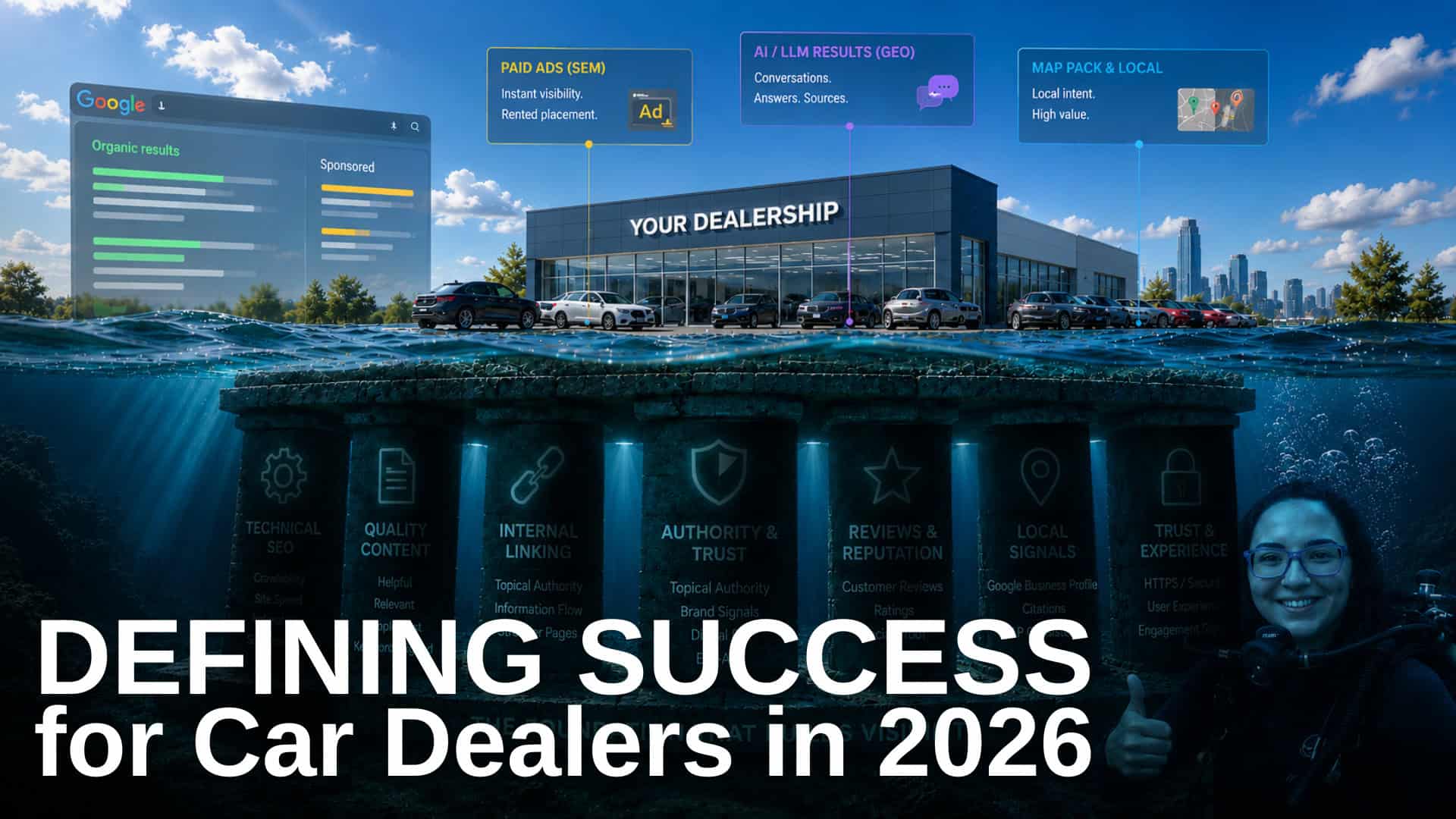
SEO means working to earn organic rankings on SERPs (Search Engine Results Pages). This is essential because organic visibility captures the majority of engagement on most SERPs.
SEM means purchasing (renting) space on search engine results pages. While paid spaces have lower click-through rates than organic positions, they can be used strategically to increase overall visibility.
GEO means being mentioned or listed as a source in LLM (Large Language Model) results, such as ChatGPT results. This is a newer way to get visibility outside of traditional SERPs.
SEO, SEM, and GEO are all different things, but they play specific roles in the automotive search space. Understanding how to be visible in each way and how the pieces fit together is essential to marketing success.
Earning & Optimizing Your Visibility
The Classics: SEO vs SEM
Traditionally, search has been divided into two main categories: organic and paid, which are where SEO and SEM come from. SEO focuses on earning visibility by becoming an authoritative source on a given topic through high-quality content and technical optimizations like internal linking, well-crafted meta titles, and site structure improvements. SEM, on the other hand, focuses on gaining visibility through paid advertising.
These two pieces of search marketing are still going strong and, together, can help you dominate your market. However, many dealerships still approach these channels inefficiently. When building a search strategy, SEO and SEM should work together strategically rather than competing for the same visibility. The goal should be to rank organically for as many keywords in as many geo locations as possible. SEM should be used to fill in the gaps; you should purchase space where you haven’t yet earned it.
Too often, dealerships are wasting spend by paying for positions on SERPs where they already rank well organically. If you already rank organically for a keyword, aggressively spending on the same term may not be the best use of budget. Why pay to rent visibility on a SERP you already dominate organically? Instead, that budget should be used to expand your dealership’s visibility in areas where it has not yet established a strong presence.
This also means you shouldn’t spend money to rank for your own name. If someone’s searching for your dealership’s name, they’re already looking for you specifically, plus you’re likely already dominating that SERP organically.
When it comes down to it, SEO should be your main player, and SEM should be used to fill in the gaps.
Where GEO Comes Into Play
It’s still early in the game for GEO, and we are keeping an eye on when, where, and why it matters to dealerships. In our working studies, we’ve found that third-party car sales sites are frequently being used as sources for vehicle-related prompts in LLMs like ChatGPT. This is because third parties have inventory from hundreds of dealerships. Since the goal of an LLM is to serve users the best possible result, sourcing from the biggest inventory pools online makes sense.
In cases where people ask who the best dealership in any given area is, LLMs are often looking at reviews and pulling real human experience to judge who the “best” is. There’s nothing you can do but make sure you are giving the best possible service to your customers. But as LLMs evolve, dealership authority, reputation, and overall digital trust signals are likely to become increasingly important.
Now, there are cases in which dealerships are ranking with high-quality content targeting the keywords (or similar keywords) to the LLM prompt. What this goes to show is that when third parties or reviews are not being relied upon, the same high-quality content that works for traditional SEO is what works for GEO.
If you don’t believe me at my word, Google released a statement in relation to their on-page AI results: “The best practices for SEO continue to be relevant because our generative AI features on Google Search are rooted in our core Search ranking and quality systems.”
But it’s important to remember that GEO is not taking over SEO; it’s simply an expansion of the ways you can be visible in search.
What’s the Future of Search?
The traditional search engine results page is not dead, and it is not dying out, at least any time soon. Google is still the main tool used for searching, making SEO and SEM just as relevant as ever. And realistically, SEO may be more pertinent now than ever when you consider the fact that LLMs value the same authority as search engines.
In terms of how GEO will develop, there are various outcomes on both the organic and paid sides. LLMs may eventually incorporate vehicle listing experiences similar to today’s VLAs, and might start leaning toward more results that prioritize specific dealerships instead of relying primarily on third-party sources.
We aren’t just sitting back and waiting for things to happen, though. At Wikimotive, we are dedicated to keeping our eye on the ball. We are going to continue watching and testing–so stay tuned.
There’s more to come with this and more opportunities for the taking. Search isn’t going extinct; it’s growing. The dealerships that succeed in the next era of search will be the ones that build visibility everywhere customers look for answers.