

This Month from Wikimotive…
January is your clean slate—an opportunity to cut the clutter, regain control, and start the year with sharper strategy (not louder tactics).
In this month’s newsletter, learn how to audit your vendor ecosystem, spend more wisely (not just more), and use competitive insights like PIPO data to make your SEO even more effective. And before you blame traffic for missed targets, we’ll tackle the truth your SEO can’t fix: your value proposition. This month is about tightening execution—and building real momentum for 2026.

A Digital Clean Slate for 2026
In 2025, your dealership likely had more than a few key players, vendors, and tools that helped keep your digital train on the tracks throughout the year. The automotive industry, in particular, is infamous for having a huge list of SaaS tools, technical services, CRMs, websites, inventory providers, SEO, DigAd, and on and on.
All of these touchpoints and technologies have payment methods, accounts, users, packages, and even technical installations on your website and/or integrations within your dealership’s selected tools. In the digital space, we refer to this as your dealership’s “Tech stack” or more broadly your “Vendor ecosystem.”
In order to do your due diligence at the dealership, you’ve likely been keeping a close eye on your store’s vendor ROI. This process inevitably sees you making the hard decision to switch providers in all sorts of different niches at all sorts of different moments throughout the year.
While this due diligence is the right move, it carries hidden headaches, such as:
- “Who am I even working with?”
- “When did that contract end?”
- “Did I offboard them completely?”
- “Do they keep my data or do I?… Where is it?”
We’ve talked before about the specific importance of monitoring old scripts and tags on your website, but more broadly, who at your dealership has the definitive list of vendors, their terms, and their touchpoints?
To not know the answer to this question, even partially, opens your dealership up to unseen costs, disorganization, and even a wide-open door by which vendors are still collecting your data long after you’ve ended your relationship with them.
We’ve worked with plenty of dealerships that were surprised by who still had access to their digital credentials or left scripts lying around on their website.
Your New Year’s resolution is to find or create your vendor ecosystem list and start 2026 strong with a clean slate.
Step 1: Compile Your Master List
Start by gathering information from multiple sources—don’t rely on just one person’s knowledge:
- Review your AP department’s recurring vendor payments.
- Check your website for all installed scripts and tracking codes.
- Audit user accounts across all platforms (who has access to what?).
- Survey department heads for tools you might have missed.
- Pull all active contracts from your files.
Step 2: Document the Details
For each vendor, create a record that includes:
- Service provided and category (CRM, Digital Advertising, Website, etc.).
- Monthly/annual cost.
- Contract end date and renewal terms.
- Primary contact person (both at your dealership and at their organization).
- Technical touchpoints (scripts on website, API integrations, data feeds).
- Data ownership and portability terms.
Step 3: Identify the Cleanup Opportunities
Now that you can see everything in one place:
- Flag vendors where contracts have already ended but services may still be active.
- Identify redundant tools that overlap in functionality.
- Note any vendors you’re paying for but not actively using.
- Highlight any vendors still collecting your data without a current agreement.
Step 4: Execute Your Offboarding Checklist
For each vendor you’re discontinuing:
☐ Confirm contract termination in writing.
☐ Remove all website scripts and tracking codes.
☐ Deactivate integrations with your CRM/DMS.
☐ Download and secure your data before access is revoked.
☐ Remove user accounts and revoke access credentials.
☐ Stop recurring payments.
☐ Verify complete removal 30 days later.
Step 5: Maintain It Going Forward
This effort will be a lot easier next year, because you will have:
- Assigned one person as the “vendor ecosystem owner”.
- Updated your master list quarterly.
- Set calendar reminders 60 days before contract renewals.
- Required all new vendor additions to go through a standardized approval and documentation process.
Don’t let another month of unnecessary costs, security risks, and data leakage slip by. Block 30 minutes on your calendar this week to start Step 1—your 2026 bottom line will thank you.

Spend More…Wisely
I work with a lot of stores. I work with small stores spending $40k/mo in marketing and looking to add more. I work with medium stores, spending $10k/mo in marketing and feeling like they spend too much.
The extreme spread is a small store that’s spending $6k/mo, including their website, to a large metro store spending about $200k/mo, and there’s everything between. So what’s the right marketing spend for your store?
There’s no one-size-fits-all answer, but for many, the answer is more than you’re spending now… as long as you allocate it wisely. The most impressive sales growth stories I’ve seen unfold over the years have been with stores that have been unafraid to say “yes and…”.
“Yes,” I’ll spend on premium SEO… “and” I want to double my SEM budget. Those who think that way, while measuring results carefully—and sticking with it when the market shows down—are the ones who appreciate compounding sales increases year after year.
There is a framework you can use for a guide, and it’s $400 per sale. As in, if you’re a store selling 100 cars/mo, your all-in marketing spend (website, radio, SEM, SEO, website tools… everything) should be $40,000 to propel steady growth.
I want to be clear that you can blow $40k on all the wrong things, so quality matters here. Assuming you’re measuring what’s producing opportunities, $400/sale is your target. Spend less, and you’re likely going to tread water.
Spend much less, and you’re going to lose ground to competition. $400/sale is the approximate sweet spot to make sure you’re pushing the envelope and capturing new opportunities without getting deep into diminishing returns.
Measure your cost per conversion for each marketing source, add more of the things that are performing best, and trim from things performing worse. Aim for $400 cost per sale overall and measure this on a multi-month average to avoid knee-jerk changes with seasonality.

The PIPO Report:
The “Secret Sauce” We’re Craving
by Dave Estey
Our SEO team is already pretty great at what they do. They have the keywords dialed in, the technical audits humming, and your Google Business Profile looking sharper than a new set of rims. Let’s be clear, we’re perfectly capable of driving traffic without any “inside info,” but if you want to turn our SEO efforts from a reliable sedan into a high-performance sports car, we need to talk about your Pump-In/Pump-Out (PIPO) report.
We’re Good, But We Could Be “Scary” Good
Think of us as a private investigator. We can find out a lot just by watching the street, but it’s a lot faster if you just hand us the file.
The PIPO report shows us exactly where your competitors are “pumping in” to your territory and where you’re successfully “pumping out” into theirs. Without it, we’re targeting your market with a wide-angle lens. With it, we’re using a laser sight.
Why It’s Our Favorite Cheat Code
Sharing that report doesn’t change what we do; it just changes where we point the heat.
- Targeted Defensive Maneuvers: If the data shows a rival dealer is sniping sales in your favorite ZIP code, we can stop “generic” blogging and start creating hyper-local content that reminds those neighbors who the real king of the cul-de-sac is.
- The “Wait, We’re Selling There?” Effect: Sometimes a PIPO report reveals you’re weirdly popular in a town two counties over. We can take that “accidental” success and turn it into an intentional SEO conquest strategy.
- Smarter Strategy, Zero Extra Work: You already have the report. We already have the tools. Combining them is like putting high-octane fuel in a car that’s already running great; it just goes faster.
Send It Over (Or Don’t, We’ll Still Crush It)
We don’t need the PIPO to get you rankings, but we’d sure love to have it to get you the right rankings. Dig it out of the sales manager’s inbox and send it our way. We promise to use our powers for good and to make your competitors’ lives a little more difficult.
The One Thing Your SEO Can’t Fix
Wikimotive has spent years helping dealers understand SEO, SEM, keyword strategy, website optimization, and even dealership management best practices. That foundation is critical. However, one thing that doesn’t get nearly enough attention is your value proposition packages, your “why buy.”
This is where many dealers are losing ground—and where competitors are quietly eating your lunch.
You might have strong SEO working hand in hand-in-hand with smart SEM campaigns that get shoppers through the door, and yet, the sales aren’t closing. When that happens, it’s time to stop looking at traffic and start looking at what you’re actually offering.
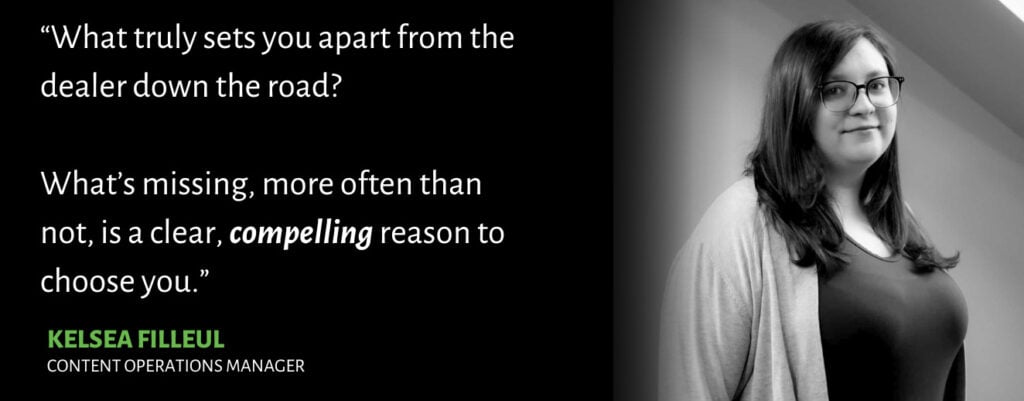
What truly sets you apart from the dealer down the road? It’s not inventory. Everyone has access to similar vehicles. It’s not rankings; shoppers don’t just buy because you’re #1 on Google. It’s not even customer service alone (important as that is for retention).
What’s missing, more often than not, is a clear, compelling reason to choose you.
Today’s buyers are stretched thin. They’re budgeting carefully, especially when committing to a $40k+ vehicle. Buyers are thinking beyond the purchase, considering maintenance, service, long-term costs, and other factors. If all you’re offering is the car itself, you’re giving them no reason to come back… or to send their friends your way.
Value doesn’t have to be complicated.
Sometimes it’s as simple as:
- Buy three tires, get one free
- Complimentary maintenance perks
- Service incentives that reward loyalty
- Benefits that make car ownership easier, not just possible
These aren’t gimmicks. They’re reassurance. They tell buyers, “We’re thinking about you after the sale.”
And that’s what builds repeat business. That’s what drives service retention. That’s what turns a single sale into a referral.
When your value proposition is clear and genuinely different, everything else works better. Your SEO brings in the right shoppers. Your SEM converts more efficiently. Your team closes more deals because there’s a real reason to say “yes.”
When everything works together, failure isn’t part of the equation.