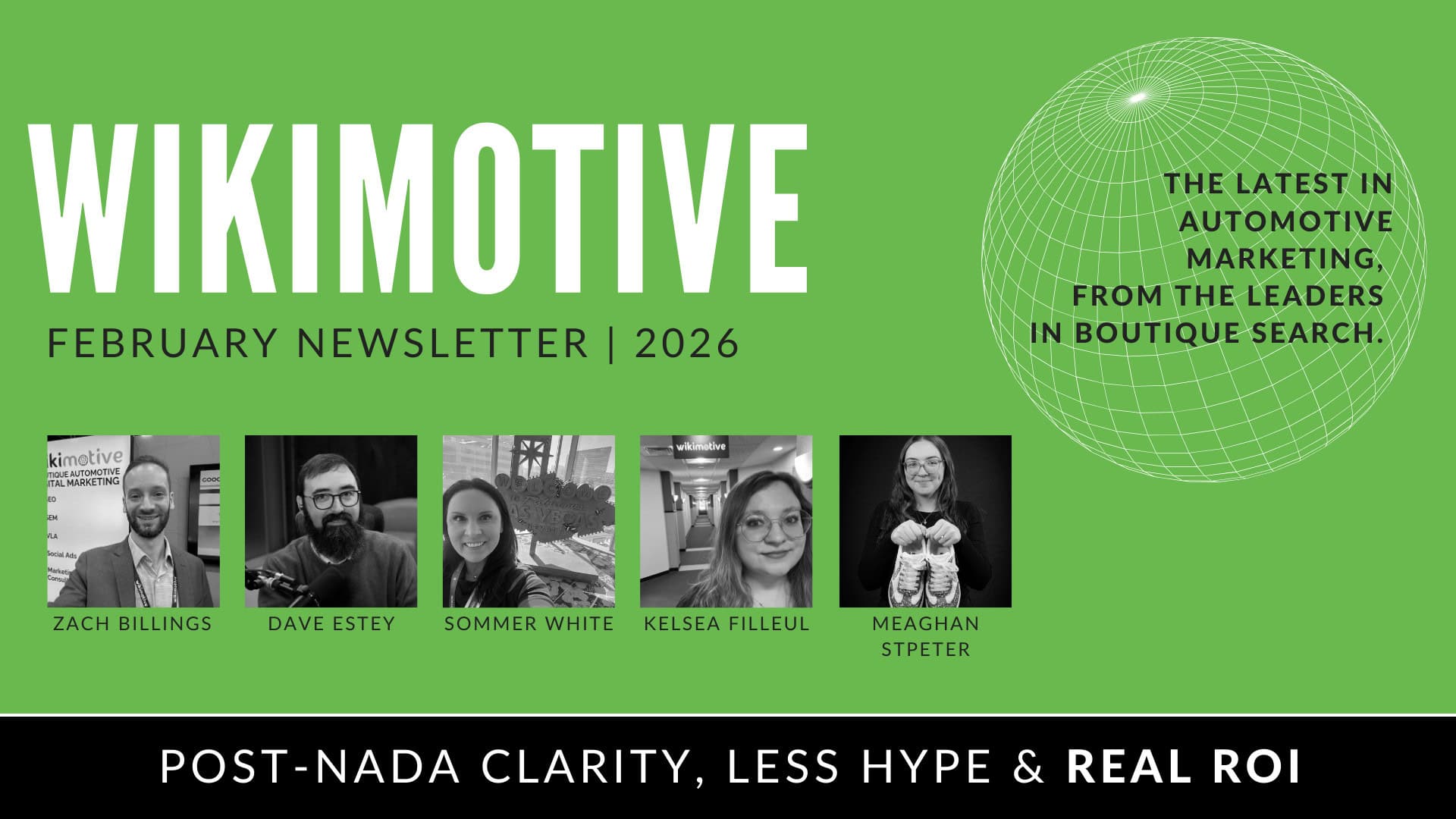
This Month from Wikimotive…
We unpack the reality behind AI “magic,” why shortcuts rarely deliver ROI, and how to approach new technology with sharper questions and stronger fundamentals.
From post-NADA reflections to the operational discipline behind high-quality SEO and content execution, we are cutting through hype, reinforcing proven processes, and making smarter decisions you can stand behind. Less chasing trends and more focus on fundamentals that deliver real results in 2026.
AI Is Costing Dealers Money
The promise of AI is to make life and work more efficient. To have AI that thinks for you and does the tedious work so you can get more productivity — more sales — out of fewer people and less time. The promise is real, but it’s nowhere near as turn-key as you’ve been led to believe.
The truth is that real AI efficiencies are being realized by people or organizations that were already highly tech-savvy. Want an AI agent to train your sales staff? That exists… but you have to develop the agent yourself from scratch, OR you have to pay to license the technology, and then you still have to train the AI agent on everything you know before it can do anything useful.
The problem is that AI is being framed as all-knowing. A fix-all technology that lets you bypass the tedious work. That’s only true if you do even more tedious work up front to get it there, and outside of big auto groups that are investing in this development internally, that’s just not happening in automotive.
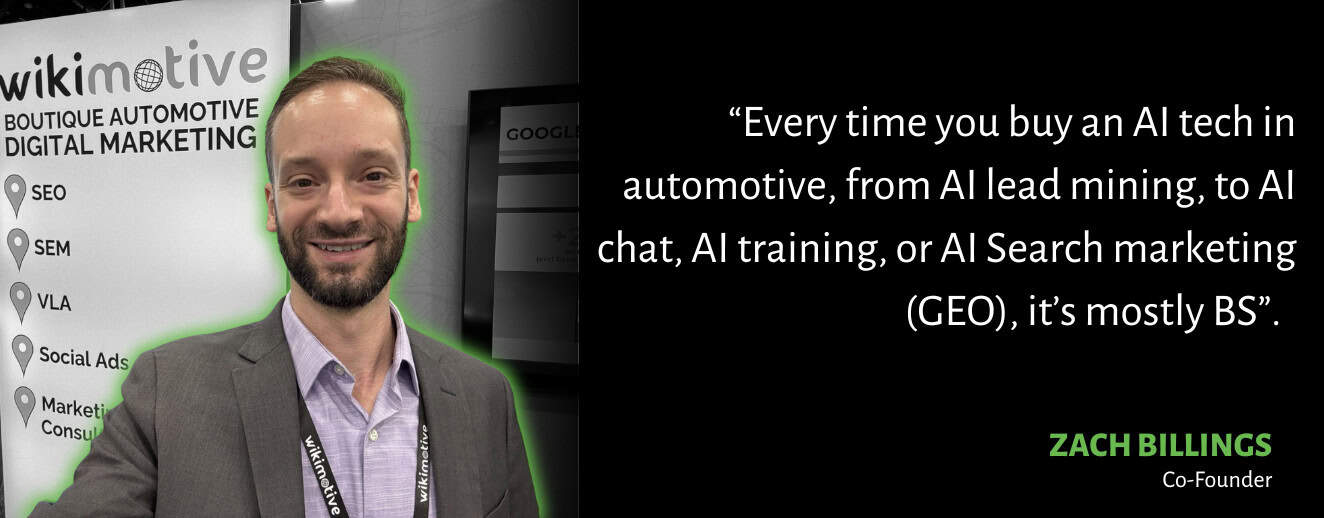
Every time you buy an AI tech in automotive, from AI lead mining to AI chat, AI training, or AI Search marketing (GEO), it’s mostly BS. There are real solutions available, but almost everything selling itself as a quick fix that you don’t have to work for is lying to you. So what can you do?
- Ask for real-world examples of how dealers are using the AI tech and bang on it yourself.
- Ask what the solution does to understand your pricing model, business, response structure (think chat agents), etc.
- Ask if there’s even a meaningful way to train the solution on your business realities and, if there is, how much time and information is needed from you.
- Treat AI solutions the same way as you have other tech solutions for years — mostly BS with a few gems in the mix, and it’s necessary to ask critical questions before you get taken for a ride.

The NADA Aftermath: Why “Magic” is a Bad Investment
By Dave Estey
If you walked the floor at NADA 2026, you saw the theater. High-budget stages, “Proprietary Agent” pitches, and promises of set-it-and-forget-it automation. But as the lights dim in Vegas, dealers are left with a sobering reality: Innovation theater doesn’t pay the floorplan.
The math of 2026 is unforgiving. Boston Consulting Group (BCG) reports that while companies plan to double their AI spending this year, 50% of CEOs believe their own jobs are on the line if these investments don’t deliver measurable ROI within the next 12 months. In the automotive world, that pressure is even higher. At Wikimotive, we believe the ROI gap exists because the industry is chasing “miracles” instead of addressing three fundamental pillars:
1. Data Sovereignty:
In 2026, data is the only asset that scales. If your AI vendor keeps the “learned intelligence” from your customer interactions when the contract ends, you aren’t building a business — you’re paying to train theirs. Capgemini notes that as we enter the “Year of Truth for AI,” sovereign models and proprietary data control are now the only ways to achieve a structural competitive advantage.
2. The Operational Gap:
Tech doesn’t fix a broken process; it amplifies it. Historically, 70% of digital transformations fail (McKinsey/BCG) due to poor alignment between new tools and existing workflows. If your managers are spending 20 minutes cleaning up a chatbot’s mess for every 5 minutes it “saves,” you haven’t optimized — you’ve just added high-tech overhead.
3. The Human Factor:
The “creep factor” is real. Capgemini’s 2026 Consumer Trends report shows that 71% of shoppers are worried about how GenAI uses their personal data. Furthermore, while they value efficiency, 70% of consumers still demand human assistance for complex, high-stakes purchases. Tricking a customer into thinking a machine is a person breaks trust before they even hit the lot.
The Bottom Line: AI is a multiplier, not a replacement. It should handle the mundane behind the scenes so your people can be the face of your brand again. If you’re looking for help finding the gold amongst the glitz and glam, give us a ring.
Three Takeaways From NADA 2026
By Sommer White
As I navigated my almost-first NADA (because last year’s “SNOLA” travel was its own experience and left many deciding not to attend), I came away with a few key takeaways.
Everyone attending is coming with their own experiences that form how they take in the words you are saying to them. NADA 2026’s word cloud was filled with versions of “AI.” AI likely does not mean the same thing when talking to a SEO-focused dealership or vendor as it does when talking to a SaaS vendor. From shiny, new tools to freshly relabeled platforms, AI can bring efficiencies in Operations, but can hurt you if you are leaning on AI for total dealership communications or website content. And is it AI or LLM, or just the same execution as before, but with “.ai” added to the end of their new company URL? Understanding that and getting on the same page with definitions will help you communicate more effectively and not dismiss something out of hand.
Relationships are the point of NADA. It’s not about selling or buying new products and services. It’s about finding the dealers and vendor partners we navigate our daily work-life with and thanking them. That might be with words, a hug, fun photos, or drinks and dinner, but taking time to make sure the external people who keep all of our businesses running know they are appreciated. Seeing faces that I had only seen on Zoom for so long in person — and recognizing them when they hadn’t recognized me yet — was probably my favorite thing about NADA this year. Genuinely enjoying the people — past and present — you work with is just not something celebrated often enough.
Competitors are not there only to compete. Synergies exist even in the most formidable competitor, and if you approach them with a stiff arm from the jump, you are doing a disservice to your company and your clients. This goes for dealers and vendors. We all have something to learn and something new to try, and why would we want to close ourselves off to that? Active listening when competitors are talking can and will make you stronger. Check the sales goals at the door and come ready to take in what can work for your business model, and leave whatever doesn’t for someone else to try.
The Engine Behind High-Quality Content
As a Content Production Manager, I have a wide-angle view of the entire content pipeline — from client communication and SEO planning to writing, editing, and final implementation. That perspective allows me to see how small production decisions directly impact how your dealership shows up online and how effectively your website turns traffic into opportunity.
When improving performance, it’s natural to focus on goals and SEO strategy. Those are critical. However, many dealerships invest in strategy and still see inconsistent results. Often, the gap isn’t the plan; it’s the execution.
One of the most overlooked drivers of strong SEO performance is the writers producing your content.
Writers are responsible for translating your voice, priorities, and competitive positioning into clear, search-optimized messaging. That requires more than a keyword list. It requires defined standards, structured feedback, and ongoing oversight to ensure content consistently aligns with your business objectives.
Without standards grounded in your voice and market, content drifts. Messaging becomes generic. Differentiation fades. Pages may rank, but they don’t convert as effectively as they should, resulting in traffic without leads and visibility without growth. When content lacks clarity, differentiation, or direction, credibility erodes, engagement drops, and opportunities are lost.
At Wikimotive, we track performance trends over time and collaborate closely with our writing team to continuously refine structure, messaging, and strategic alignment. The result isn’t just more content; it’s content built to support lead generation, reinforce your competitive position, and build long-term trust with shoppers.
Consistency matters. But ongoing refinement is what drives sustainable performance. Great content isn’t accidental; it’s built through collaboration, accountability, and disciplined execution at every stage.
What does this mean for your dealership? The more clearly you communicate your voice, priorities, and performance goals, the more precisely writers can align content to support them.
When strategy, production, and communication work together, content becomes more than a deliverable; it becomes a measurable growth driver. Whether you work with us or not, clear standards, active oversight, and ongoing refinement are what turn strategy into results.
First 10 Steps: Getting Started With SEO
Step One: Getting a Feel for Where You’re At
Taking the first steps toward change is never easy. When the change is as complex as implementing an SEO strategy for your dealership, it’s hard to know where to start. The first step to doing so is actually the easiest and the most eye-opening, though: Getting a feel for where you’re at currently.
Using a Website Crawler & Checking for Major Errors
A significant portion of understanding your website’s current value comes from crawling the website with a tool that mimics search engine crawlers, such as ScreamingFrog. These tools collect tons of information from the website and can help you make a list of things that need to be worked on.
This list may include:
- Investigating pages that are broken (404 errors) and finding a resolution.
- Optimizing meta titles.
- Optimizing H1s.
- Replacing broken images.
A simple site crawl can give you tons to work with, and putting it all together in a list makes it easier to review and prioritize. Stay tuned — I’ll cover the importance of each of these items and how to tackle them in more detail later in this series.
Clicking Through & Making Notes About Your Website
The other way to gather items to add to your list is to simply click through your website. This helps you get the lay of the land and can help you find things like:
- Pages that need quality content added to them.
- Any existing internal linking structure.
- Broken tools.
Adding these findings to your action plan will help create a significant roadmap for improvements.
Fixing What You Find
Once you have a list of things to fix, gathered from your crawl and visual inspection, it’s time to start chipping away at it. Tune in to next month’s newsletter, where I’ll be talking about step two: how to identify the cause of broken pages and tools, and how to fix them.