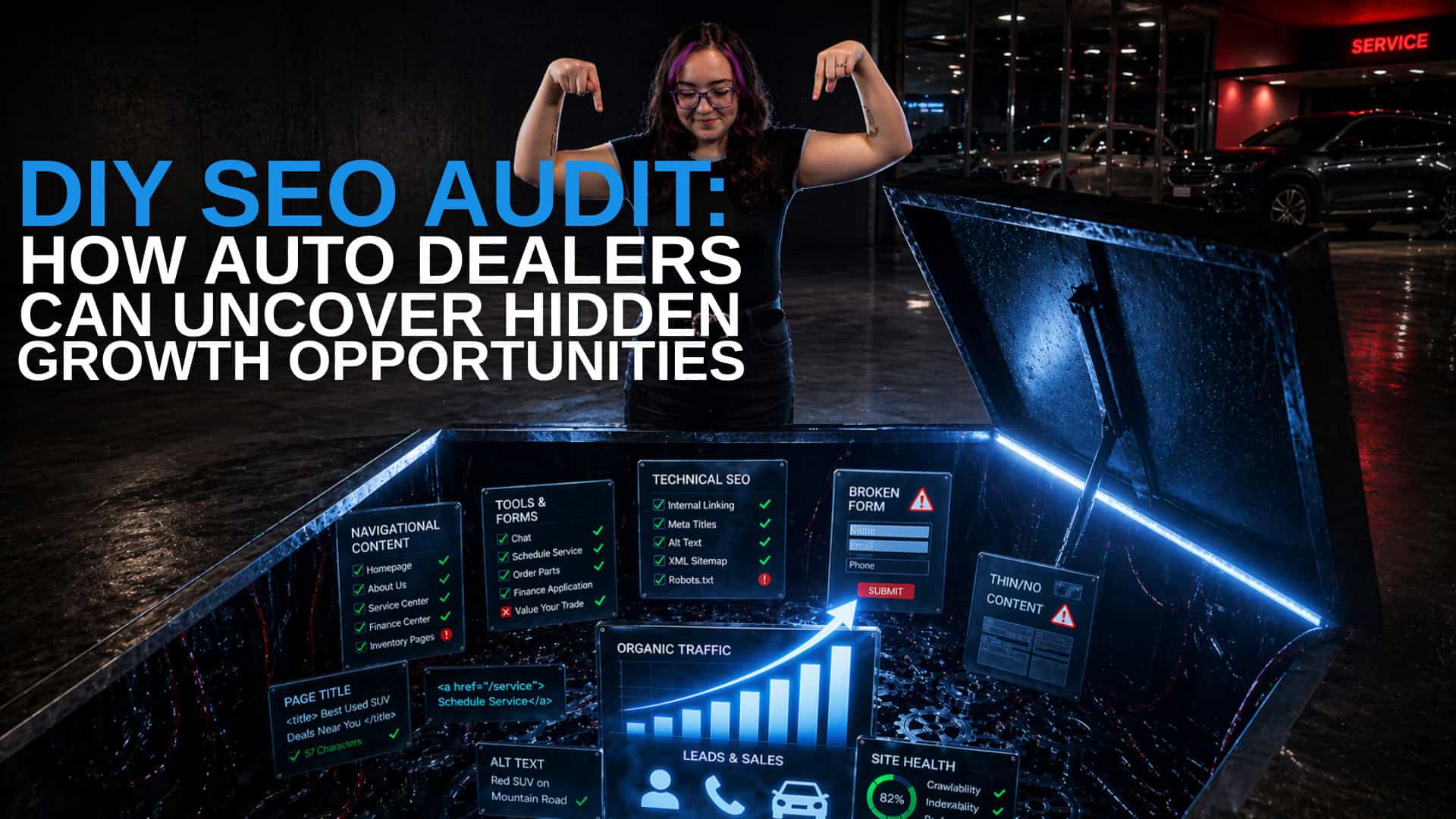
Most dealership websites have untapped potential that won’t be found by simply looking at a reporting dashboard. To uncover meaningful opportunities for improvement, you need to go straight to the source: your website. A visual audit focused on the existence and quality of navigational content, tool functionality, and technical SEO provides direct insight into what’s helping or hurting your automotive SEO performance. Here’s the framework we use to identify those opportunities.
Analyzing Your Navigational Content
Having high-quality content on your dealership’s navigational pages is a powerful way to impact authority and overall website quality. This content makes it easier for visitors to find answers to their questions and, in turn, makes the pages more valuable in the eyes of search engines and LLMs.
When doing this part of your visual audit, the first question is whether you have content on your website’s main navigational pages, such as the Homepage, About Us page, Service Center Page, Finance Center page, and Inventory SRPs. If the answer is, “yes, there is content on these pages,” then you have to determine whether or not the content meets the standard of high-quality.
High-quality navigational page content means content that:
- Is focused on the topic of the page.
- Is helpful and answers common car-shopper questions.
- Is easy to scan with clear headers and structure.
- Is written for humans first, not search engines.
- Isn’t stuffed with keywords or geos.
- Isn’t duplicate content from another page.
- Isn’t overly thin or generalized.
While going through this audit, make note of pages that don’t have any content or have poorly written content on them so that you can prioritize getting high-quality content on the pages going forward.
Ensuring Your Tools and Forms Functionality
After looking at the content on the pages, it’s a good idea to make sure that all of your tools are functioning properly. Not only is tool functionality important for a good user experience, they’re also important in ensuring that users who want to convert can.
A run-through to make sure the following tools are working properly is a quick and easy way to catch issues:
- Chat
- Schedule Service
- Order Parts
- Finance Application
- Value Your Trade
Simply use the tool or fill out the form to make sure it doesn’t give you any issues. If you find anything broken, immediately contact your website provider or the third-party tool provider to resolve the issue. If you don’t find anything, you’re good to go!
Assessing Your Technical SEO
Technical SEO should also be assessed when you do a visual audit of your website. This can seem like a complicated endeavor, but you don’t have to be an expert to identify places for improvement.
Click through your site to see if:
- There is internal linking. Internal links help search engines easily crawl and understand the website, build the website’s authority for certain terms/on certain pages, and help funnel users toward conversion. When you do your audit, make sure there is internal linking on the website and, if there is, whether it is done in a way that pushes authority to main pages and funnels users toward pages where they could convert.
- Meta titles are optimized. Meta titles are direct ranking factors as they help search engines understand what the page is and open opportunities for placing search terms and target geos within them. If your meta titles don’t relate to the pages they’re on, don’t make sense when reading, or aren’t optimized, they could be improved. If they’re shorter than about 57 characters, they’re likely not best using the space provided. And if they’re longer than 65 characters, they’re likely not displaying properly on search engine results pages (SERPs).
- Alt text is accurate and optimized. While not a strong ranking factor, alt text still helps search engines better understand images and the page overall. It also improves accessibility for users who rely on screen readers and provides an additional opportunity to reinforce relevant keywords and context on the page. You can right-click on an image and click “inspect” to see if it has alt text and if that alt text accurately reflects the image.
Other elements to look at are your XML sitemap and Robots.txt file. Your XML sitemap should include all of your website’s pages, so simply making sure the pages are in there and that nothing looks obviously wrong is a good thing to check every once in a while. XML sitemaps are submitted directly to Google via Google Search Console, so ensuring they have the pages listed is important.
Similarly, the Robots.txt file just needs a glance. Make sure the Disallow list doesn’t include search engines like Google, which would prevent Google from being able to crawl the website.
As you take a look at these things, make note of where improvements are needed so that, like the navigational page list, you can prioritize what needs to be done and when.
Getting Your Website Optimized
It’s important to remember that the goal of evaluating your navigational content, tools, and technical SEO isn’t to fix everything at once; it’s to build a clear, actionable list of opportunities. Understanding your website’s current state allows you to prioritize what needs immediate attention and create a plan for what comes next.
If you’re not sure where to start, or want expert guidance in turning those insights into results, Wikimotive is here to help. Contact us to partner with an automotive SEO team that knows how to turn opportunity into performance.